
 Welcome
For You
For APIdia
Contact
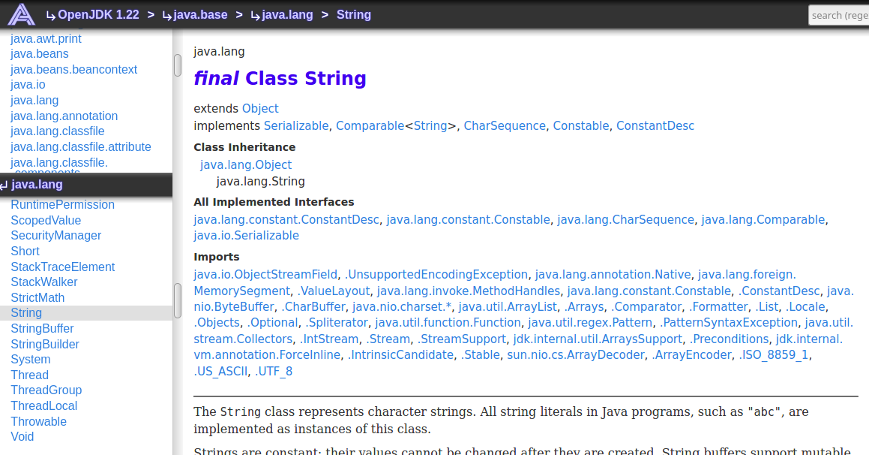 Most importantly, APIdia restores the well-established three-frame project navigation in a future-proof way (referring to EOL of frame and frameset html elements). While you browse APIdia, the site maintains a parameterized url storing frame states suitable for linking and bookmarking.
Another major improvement is rigorous interlinking both within a project (including links to imports and overridden, implemented, hidden methods) and accross distinct projects. For nearly every project hosted on APIdia, the entire dependency tree is hosted as well. You will rarely find an object type or member name that is not linked to its API documentation.
 Summaries come with tooltips for method args and are processed in a smarter way. They do not prematurely terminate at abbreviations like "e.g.". Methods indicate overridden, implemented or hidden methods by a link.
Docs always include private and internal API, which is hidden by default and can be activated via the top right menu.
 APIdia's search is notably faster than Javadoc's – it reacts instantaneously on typing. Furthermore, it supports regex and has a clean design that makes smart use of sticky html elements for presenting the dropdown search results.
The whole site is lightweight and swift. It avoids heavy scripts, frameworks and analytics, allowing operation without annoying cookie banners. And of course, APIdia is free and will stay free.
That said, the best way to get an impression is to just delve into some of the docs. Check out the Java standard library, Jakarta EE, Guava, JavaFX, JUnit, Bouncy Castle, Netty and many more.
Are you a core developer of a library? If your library is hosted on APIdia, you can effortlessly browse internal API of a complex code base. You can instantly switch back and forth between private and public API to assess the user experience of your library documentation.
For learners starting to use the standard library and popular utility libs, the three-frame structure provides a unique way to explore API at their own pace while always keeping a good overview. Javadoc replaced project navigation by a search, but browsing and searching are really two things. Especially as a learner, you hardly know what you should be searching for from the start. Browsing and exploring helps you understand a project and its design choices.
The benefit to learners is of equal relevance to educators. If you are an educator, you can use APIdia to familiarize your students with the structure of libraries. Do you want to use APIdia in your programming course? Tell us about it and we may feature your course on the page.
For all developers, APIdia provides a documentation look and feel that is going to be stable and reliable in the long run. No crucial features will be taken away. We understand developers and know how annoying it is when changes are made just for the sake of change. We know how tiresome it is when products degenerate to bloatware. We understand the importance of a fast, lightweight and professional site. These values are baked deeply into APIdia and are here to stay. That is our promise. Let us earn your trust.
Spread the word. Show APIdia to your colleagues and follow us on Mastodon @APIdia
If you have a feature request, open a discussion on our Github page. Tell us if a project of relevance to you is missing on APIdia. Same for (specific) legacy versions or pre-releases of hosted or yet unhosted projects. Do you want to host API documentation of a closed-source project? Get in touch. We offer a process to submit API documentation data without having to share the source code. Still suffer from a painpoint? Let us know!
If you are a library maintainer, place the APIdia badge in your readme, e.g. on Github. Drop us a note if your library is not hosted on APIdia yet – we will process it with priority.
Become a partner. Are you running a Java, programming or tech website or a small company? Let's cooperate. We are launching a program to feature projects or organizations that adopt APIdia for their docs, blog about it, use it for education or some other case. Get in touch and tell us your use case!
Become a sponsor. As part of the same program, we will present sponsors on APIdia. Furthermore, sponsors will be mentioned in our social media posts and in talks on JUG meetings and conferences. Contact us to learn more!