


Publisher
Publisher with rx operators that emits 0 to N elements, and then completes
(successfully or with an error).
The recommended way to learn about the Flux API and discover new operators is
through the reference documentation, rather than through this javadoc (as opposed to
learning more about individual operators). See the
"which operator do I need?" appendix.
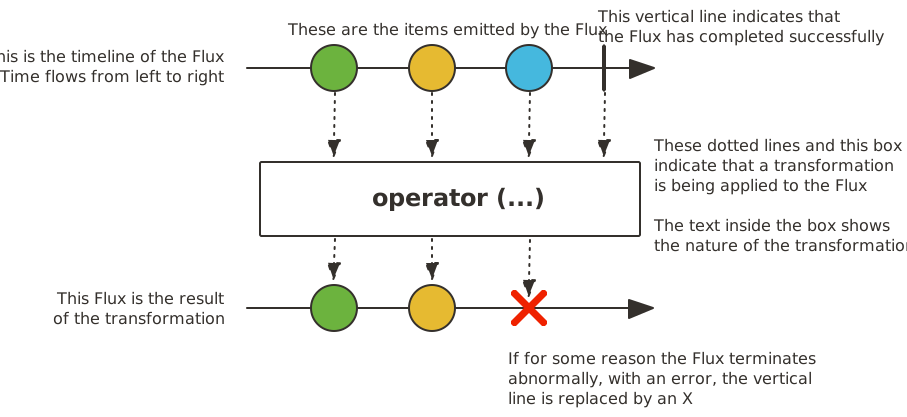
It is intended to be used in implementations and return types. Input parameters should keep using raw
Publisher as much as possible.
If it is known that the underlying Publisher will emit 0 or 1 element, Mono should be used
instead.
Note that using state in the java.util.function / lambdas used within Flux operators
should be avoided, as these may be shared between several Subscribers.
subscribe(CoreSubscriber) is an internal extension to
subscribe(Subscriber) used internally for Context passing. User
provided Subscriber may
be passed to this "subscribe" extension but will loose the available
per-subscribe Hooks#onLastOperator.
Mono
| Modifier and Type | Field and Description |
|---|---|
| pack-priv static final BooleanSupplier | |
| pack-priv static final Function | |
| pack-priv static final Supplier | |
| pack-priv static final BiPredicate | |
| pack-priv static final Supplier | |
| pack-priv static final BiFunction |
| Access | Constructor and Description |
|---|---|
| public |
| Modifier and Type | Method and Description |
|---|---|
| public final Mono | |
| public final Mono | |
| public final < the returned instance type P> P | |
| public final T | Returns: the first value or nullSubscribe to this |
| public final T | Returns: the first value or nullmaximum time period to wait for before raising a timeout)RuntimeExceptionSubscribe to this |
| public final T | |
| public final T | Returns: the last value or nullmaximum time period to wait for before raising a timeout)RuntimeExceptionSubscribe to this |
| public final Flux | |
| public final Flux | |
| public final < the C extends CollectionCollection buffer type | buffer(int
the maximum collected size maxSize, Supplier<C> a bufferSupplier)Supplier of the concrete Collection to use for each bufferCollect incoming values into multiple user-defined |
| public final Flux | |
| public final < the C extends CollectionCollection buffer type | buffer(int
the max collected size maxSize, int the number of items to count before creating a new buffer skip, Supplier<C> a bufferSupplier)Supplier of the concrete Collection to use for each bufferCollect incoming values into multiple user-defined |
| public final Flux | |
| public final < the C extends CollectionCollection buffer type | buffer(Publisher<?>
the companion other, Supplier<C> Publisher whose signals trigger new buffersa bufferSupplier)Supplier of the concrete Collection to use for each bufferCollect incoming values into multiple user-defined |
| public final Flux | |
| public final Flux | |
| public final Flux | buffer(Duration
the duration from buffer creation until a buffer is closed and emitted bufferingTimespan, Scheduler a time-capable timer)Scheduler instance to run onCollect incoming values into multiple |
| public final Flux | buffer(Duration
the duration from buffer creation until a buffer is closed and emitted bufferingTimespan, Duration the interval at which to create a new buffer openBufferEvery, Scheduler a time-capable timer)Scheduler instance to run onCollect incoming values into multiple |
| public final Flux | bufferTimeout(int
the max collected size maxSize, Duration the timeout enforcing the release of a partial buffer maxTime)Collect incoming values into multiple |
| public final < the C extends CollectionCollection buffer type | bufferTimeout(int
the max collected size maxSize, Duration the timeout enforcing the release of a partial buffer maxTime, Supplier<C> a bufferSupplier)Supplier of the concrete Collection to use for each bufferCollect incoming values into multiple user-defined |
| public final Flux | bufferTimeout(int
the max collected size maxSize, Duration the timeout enforcing the release of a partial buffer maxTime, Scheduler a time-capable timer)Scheduler instance to run onCollect incoming values into multiple |
| public final < the C extends CollectionCollection buffer type | bufferTimeout(int
the max collected size maxSize, Duration the timeout enforcing the release of a partial buffer maxTime, Scheduler a time-capable timer, Supplier<C> Scheduler instance to run ona bufferSupplier)Supplier of the concrete Collection to use for each bufferCollect incoming values into multiple user-defined |
| public final Flux | bufferTimeout(int
the max collected size maxSize, Duration the timeout enforcing the release of a partial buffer maxTime, boolean If fairBackpressure)true, prefetches maxSize * 4 from upstream and replenishes the buffer when the downstream demand is satisfactory.
When false, no prefetching takes place and a single buffer is always ready to be pushed downstream.Collect incoming values into multiple |
| public final Flux | bufferTimeout(int
the max collected size maxSize, Duration the timeout enforcing the release of a partial buffer maxTime, Scheduler a time-capable timer, boolean Scheduler instance to run onIf fairBackpressure)true, prefetches maxSize * 4 from upstream and replenishes the buffer when the downstream demand is satisfactory.
When false, no prefetching takes place and a single buffer is always ready to be pushed downstream.Collect incoming values into multiple |
| public final < the C extends CollectionCollection buffer type | bufferTimeout(int
the max collected size maxSize, Duration the timeout enforcing the release of a partial buffer maxTime, Supplier<C> a bufferSupplier, boolean Supplier of the concrete Collection to use for each bufferIf fairBackpressure)true, prefetches maxSize * 4 from upstream and replenishes the buffer when the downstream demand is satisfactory.
When false, no prefetching takes place and a single buffer is always ready to be pushed downstream.Collect incoming values into multiple user-defined |
| public final < the C extends CollectionCollection buffer type | bufferTimeout(int
the max collected size maxSize, Duration the timeout enforcing the release of a partial buffer maxTime, Scheduler a time-capable timer, Supplier<C> Scheduler instance to run ona bufferSupplier, boolean Supplier of the concrete Collection to use for each bufferIf fairBackpressure)true, prefetches maxSize * 4 from upstream and replenishes the buffer when the downstream demand is satisfactory.
When false, no prefetching takes place and a single buffer is always ready to be pushed downstream.Collect incoming values into multiple user-defined |
| public final Flux | |
| public final Flux | bufferUntil(Predicate<? super T>
a predicate that triggers the next buffer when it becomes true. predicate, boolean set to true to include the triggering element in the new buffer rather than the old. cutBefore)Collect incoming values into multiple |
| public final Flux | bufferUntilChanged()
Collect subsequent repetitions of an element (that is, if they arrive right after
one another) into multiple |
| public final <V> Flux | bufferUntilChanged(Function<? super T, ? extends V>
function to compute comparison key for each element keySelector)Collect subsequent repetitions of an element (that is, if they arrive right after
one another), as compared by a key extracted through the user provided |
| public final <V> Flux | bufferUntilChanged(Function<? super T, ? extends V>
function to compute comparison key for each element keySelector, BiPredicate<? super V, ? super V> predicate used to compare keys keyComparator)Collect subsequent repetitions of an element (that is, if they arrive right after
one another), as compared by a key extracted through the user provided |
| public final < the element type of the buffer-opening sequence U, the element type of the buffer-closing sequence V> Flux | bufferWhen(Publisher<U>
a companion bucketOpening, Function<? super U, ? extends Publisher<V>> Publisher to subscribe for buffer creation signals.a factory that, given a buffer opening signal, returns a companion
closeSelector)Publisher to subscribe to for buffer closure and emission signals.Collect incoming values into multiple |
| public final < the element type of the buffer-opening sequence U, the element type of the buffer-closing sequence V, the C extends CollectionCollection buffer type | Returns: a microbatchedFlux of Collection delimited by an opening Publisher and a relative
closing Publishera companion bucketOpening, Function<? super U, ? extends Publisher<V>> Publisher to subscribe for buffer creation signals.a factory that, given a buffer opening signal, returns a companion
closeSelector, Supplier<C> Publisher to subscribe to for buffer closure and emission signals.a bufferSupplier)Supplier of the concrete Collection to use for each bufferCollect incoming values into multiple user-defined |
| public final Flux | |
| public final Flux | Returns: a replayingFluxTurn this |
| public final Flux | Returns: a replayingFluxnumber of elements retained in cache history)Turn this |
| public final Flux | Returns: a replayingFluxTime-to-live for each cached item and post termination. ttl)Turn this |
| public final Flux | |
| public final Flux | Returns: a replayingFluxnumber of elements retained in cache history, Duration Time-to-live for each cached item and post termination. ttl)Turn this |
| public final Flux | |
| public final Flux | |
| public final < the E> FluxFlux output type | |
| public final Flux | Returns: the assembly tracingFlux.Activate traceback (full assembly tracing) for this particular |
| public final Flux | Returns: the assembly markedFluxa unique enough description to include in the light assembly traceback. description)Activate traceback (assembly marker) for this particular |
| public final Flux | Returns: the assembly markedFlux.a description (must be unique enough if forceStackTrace is set
to false). description, boolean false to make a light checkpoint without a stacktrace, true
to use a stack trace. forceStackTrace)Activate traceback (full assembly tracing or the lighter assembly marking depending on the
|
| public final < the container type E> Mono | Returns: aMono of the collected container on completethe supplier of the container instance for each Subscriber containerSupplier, BiConsumer<E, ? super T> a consumer of both the container instance and the value being currently collected collector)Collect all elements emitted by this |
| public final < the container type R, The mutable accumulation type A> Mono | Returns: aMono of the collected container on completethe collector)CollectorCollect all elements emitted by this |
| public final Mono | |
| public final < the type of the key extracted from each source element K> Mono | |
| public final < the type of the key extracted from each source element K, the type of the value extracted from each source element V> Mono | |
| public final < the type of the key extracted from each source element K, the type of the value extracted from each source element V> Mono | collectMap(final Function<? super T, ? extends K> keyExtractor, final Function<? super T, ? extends V> valueExtractor, Supplier<Map<K, V>>
a mapSupplier)Map factory called for each SubscriberCollect all elements emitted by this |
| public final < the type of the key extracted from each source element K> Mono | |
| public final < the type of the key extracted from each source element K, the type of the value extracted from each source element V> Mono | |
| public final < the type of the key extracted from each source element K, the type of the value extracted from each source element V> Mono | collectMultimap(final Function<? super T, ? extends K> keyExtractor, final Function<? super T, ? extends V> valueExtractor, Supplier<Map<K, Collection<V>>> mapSupplier)
Collect all elements emitted by this |
| public final Mono | |
| public final Mono | collectSortedList(Comparator<? super T>
a comparator)Comparator to sort the items of this sequencesCollect all elements emitted by this |
| public static < type of the value from sources T, The produced output after transformation by the given combinator V> Flux | Returns: aFlux based on the produced combinationsThe aggregate function that will receive the latest value from each upstream and return the value
to signal downstream combinator, Publisher<? extends T>... The sources)Publisher sources to combine values fromBuild a |
| public static < type of the value from sources T, The produced output after transformation by the given combinator V> Flux | Returns: aFlux based on the produced combinationsThe aggregate function that will receive the latest value from each upstream and return the value
to signal downstream combinator, int The demand sent to each combined source prefetch, Publisher<? extends T>... PublisherThe sources)Publisher sources to combine values fromBuild a |
| public static < type of the value from source1 T1, type of the value from source2 T2, The produced output after transformation by the given combinator V> Flux | Returns: aFlux based on the produced combinationsThe first source1, Publisher<? extends T2> Publisher source to combine values fromThe second source2, BiFunction<? super T1, ? super T2, ? extends V> Publisher source to combine values fromThe aggregate function that will receive the latest value from each upstream and return the value
to signal downstream combinator)Build a |
| public static < type of the value from source1 T1, type of the value from source2 T2, type of the value from source3 T3, The produced output after transformation by the given combinator V> Flux | Returns: aFlux based on the produced combinationsThe first source1, Publisher<? extends T2> Publisher source to combine values fromThe second source2, Publisher<? extends T3> Publisher source to combine values fromThe third source3, Function<Object[], V> Publisher source to combine values fromThe aggregate function that will receive the latest value from each upstream and return the value
to signal downstream combinator)Build a |
| public static < type of the value from source1 T1, type of the value from source2 T2, type of the value from source3 T3, type of the value from source4 T4, The produced output after transformation by the given combinator V> Flux | Returns: aFlux based on the produced combinationsThe first source1, Publisher<? extends T2> Publisher source to combine values fromThe second source2, Publisher<? extends T3> Publisher source to combine values fromThe third source3, Publisher<? extends T4> Publisher source to combine values fromThe fourth source4, Function<Object[], V> Publisher source to combine values fromThe aggregate function that will receive the latest value from each upstream and return the value
to signal downstream combinator)Build a |
| public static < type of the value from source1 T1, type of the value from source2 T2, type of the value from source3 T3, type of the value from source4 T4, type of the value from source5 T5, The produced output after transformation by the given combinator V> Flux | Returns: aFlux based on the produced combinationsThe first source1, Publisher<? extends T2> Publisher source to combine values fromThe second source2, Publisher<? extends T3> Publisher source to combine values fromThe third source3, Publisher<? extends T4> Publisher source to combine values fromThe fourth source4, Publisher<? extends T5> Publisher source to combine values fromThe fifth source5, Function<Object[], V> Publisher source to combine values fromThe aggregate function that will receive the latest value from each upstream and return the value
to signal downstream combinator)Build a |
| public static < type of the value from source1 T1, type of the value from source2 T2, type of the value from source3 T3, type of the value from source4 T4, type of the value from source5 T5, type of the value from source6 T6, The produced output after transformation by the given combinator V> Flux | Returns: aFlux based on the produced combinationsThe first source1, Publisher<? extends T2> Publisher source to combine values fromThe second source2, Publisher<? extends T3> Publisher source to combine values fromThe third source3, Publisher<? extends T4> Publisher source to combine values fromThe fourth source4, Publisher<? extends T5> Publisher source to combine values fromThe fifth source5, Publisher<? extends T6> Publisher source to combine values fromThe sixth source6, Function<Object[], V> Publisher source to combine values fromThe aggregate function that will receive the latest value from each upstream and return the value
to signal downstream combinator)Build a |
| public static < The common base type of the values from sources T, The produced output after transformation by the given combinator V> Flux | Returns: aFlux based on the produced combinationsThe list of sources, Function<Object[], V> Publisher sources to combine values fromThe aggregate function that will receive the latest value from each upstream and return the value
to signal downstream combinator)Build a |
| public static < The common base type of the values from sources T, The produced output after transformation by the given combinator V> Flux | Returns: aFlux based on the produced combinationsThe list of sources, int Publisher sources to combine values fromdemand produced to each combined source prefetch, Function<Object[], V> PublisherThe aggregate function that will receive the latest value from each upstream and return the value
to signal downstream combinator)Build a |
| public static < The type of values in both source and output sequences T> Flux | |
| public static < The type of values in both source and output sequences T> Flux | |
| public static < The type of values in both source and output sequences T> Flux | Returns: a newFlux concatenating all inner sources sequencesthe number of Publishers to prefetch from the outer prefetch)PublisherConcatenate all sources emitted as an onNext signal from a parent |
| public static < The type of values in both source and output sequences T> Flux | |
| public static < The type of values in both source and output sequences T> Flux | Returns: a newFlux concatenating all inner sources sequences, delaying errorsConcatenate all sources emitted as an onNext signal from a parent |
| public static < The type of values in both source and output sequences T> Flux | Returns: a newFlux concatenating all inner sources sequences until complete or errornumber of elements to prefetch from the source, to be turned into inner Publishers prefetch)Concatenate all sources emitted as an onNext signal from a parent |
| public static < The type of values in both source and output sequences T> Flux | Returns: a newFlux concatenating all inner sources sequences until complete or errordelay error until all sources have been consumed instead of
after the current source delayUntilEnd, int the number of Publishers to prefetch from the outer prefetch)PublisherConcatenate all sources emitted as an onNext signal from a parent |
| public static < The type of values in both source and output sequences T> Flux | Returns: a newFlux concatenating all source sequencesConcatenate all sources provided as a vararg, forwarding elements emitted by the sources downstream. |
| public final < the produced concatenated type V> Flux | Returns: a concatenatedFluxthe function to transform this sequence of T into concatenated sequences of V mapper)Transform the elements emitted by this |
| public final < the produced concatenated type V> Flux | Returns: a concatenatedFluxthe function to transform this sequence of T into concatenated sequences of V mapper, int the number of values to prefetch from upstream source, or prefetch)0 to disable prefetchingTransform the elements emitted by this |
| public final < the produced concatenated type V> Flux | Returns: a concatenatedFluxthe function to transform this sequence of T into concatenated sequences of V mapper, boolean delay error until all sources have been consumed instead of
after the current source delayUntilEnd, int the number of values to prefetch from upstream source, or prefetch)0 to disable prefetchingTransform the elements emitted by this |
| public final < the merged output sequence type R> Flux | Returns: a concatenation of the values from the Iterables obtained from each element in thisFluxTransform the items emitted by this |
| public final < the merged output sequence type R> Flux | Returns: a concatenation of the values from the Iterables obtained from each element in thisFluxthe number of values to request from the source upon subscription, to be transformed to prefetch)IterableTransform the items emitted by this |
| public final Flux | |
| public final Flux | Returns: a newFlux concatenating all source sequencesThe values to concatenate values)Concatenates the values to the end of the <img class="marble" src="doc-files/marbles/concatWithValues.svg" alt=""> |
| public final Flux | contextCapture()
If context-propagation library
is on the classpath, this is a convenience shortcut to capture thread local values during the
subscription phase and put them in the |
| public final Flux | Returns: a contextualizedFluxthe contextToAppend)ContextView to merge with the downstream Context,
resulting in a new more complete Context that will be visible from upstream.Enrich the |
| public final Flux | |
| public final Mono | |
| pack-priv static BooleanSupplier | |
| pack-priv static <O> Predicate | |
| public static < The type of values in the sequence T> Flux | |
| public static < The type of values in the sequence T> Flux | Returns: aFluxConsume the emitter, FluxSink.FluxSink provided per-subscriber by Reactor to generate signals.the backpressure mode, see backpressureOverflowStrategy for the
available backpressure modesProgrammatically create a |
| public final Flux | Returns: a newFluxthe alternate value if this sequence is empty defaultV)Provide a default unique value if this sequence is completed without any data <img class="marble" src="doc-files/marbles/defaultIfEmpty.svg" alt=""> |
| public static < the type of values passing through the T> FluxFlux | |
| public static < the type of values passing through the T> FluxFlux | deferContextual(Function<ContextView, ? extends Publisher<T>> contextualPublisherFactory)
Lazily supply a |
| public final Flux | Returns: a delayedFluxduration by which to delay each delay)Subscriber#onNext signalDelay each of this |
| public final Flux | Returns: a delayedFluxperiod to delay each delay, Scheduler Subscriber#onNext signala time-capable timer)Scheduler instance to delay each signal onDelay each of this |
| public final Flux | |
| public final Flux | |
| public final Flux | Returns: a delayedFluxduration before subscribing this delay)FluxDelay the |
| public final Flux | Returns: a delayedFluxa time-capable timer)Scheduler instance to run onDelay the |
| public final < the other source type U> Flux | Returns: a delayedFluxa companion subscriptionDelay)Publisher whose onNext/onComplete signal will trigger the subscriptionDelay the |
| public final Flux | Returns: this Flux, but with elements delayed until their derived publisher terminates.Subscribe to this |
| public final < the dematerialized type X> Flux | Returns: a dematerializedFluxAn operator working only if this |
| public final Flux | Returns: a filteringFlux only emitting distinct valuesFor each |
| public final < the type of the key extracted from each value in this sequence V> Flux | Returns: a filteringFlux only emitting values with distinct keysfunction to compute comparison key for each element keySelector)For each |
| public final < the type of the key extracted from each value in this sequence V, the type of Collection used for distinct checking of keys C extends Collection | Returns: a filteringFlux only emitting values with distinct keysfunction to compute comparison key for each element keySelector, Supplier<C> supplier of the distinctCollectionSupplier)Collection used for distinct
check through add of the key.For each |
| public final < the type of the key extracted from each value in this sequence V, the type of store backing the C> FluxBiPredicate | Returns: a filteringFlux only emitting values with distinct keysfunction to compute comparison key for each element keySelector, Supplier<C> supplier of the arbitrary store object used in distinct
checks along the extracted key. distinctStoreSupplier, BiPredicate<C, V> the distinctPredicate, Consumer<C> BiPredicate to apply to the arbitrary store +
extracted key to perform a distinct check. Since nothing is assumed of the store,
this predicate should also add the key to the store as necessary.the cleanup callback to invoke on the store upon termination. cleanup)For each |
| public final Flux | Returns: a filteringFlux with only one occurrence in a row of each element
(yet elements can repeat in the overall sequence)Filter out subsequent repetitions of an element (that is, if they arrive right after one another). |
| public final < the type of the key extracted from each value in this sequence V> Flux | Returns: a filteringFlux with only one occurrence in a row of each element of
the same key (yet element keys can repeat in the overall sequence)function to compute comparison key for each element keySelector)Filter out subsequent repetitions of an element (that is, if they arrive right after
one another), as compared by a key extracted through the user provided |
| public final < the type of the key extracted from each value in this sequence V> Flux | Returns: a filteringFlux with only one occurrence in a row of each element
of the same key for which the predicate returns true (yet element keys can repeat
in the overall sequence)function to compute comparison key for each element keySelector, BiPredicate<? super V, ? super V> predicate used to compare keys. keyComparator)Filter out subsequent repetitions of an element (that is, if they arrive right
after one another), as compared by a key extracted through the user provided |
| public final Flux | Returns: an observedFluxthe callback to call after afterTerminate)Subscriber#onComplete or Subscriber#onErrorAdd behavior (side-effect) triggered after the |
| public final Flux | Returns: an observedFluxthe callback to execute after a terminal signal (complete, error
or cancel) onFinally)Add behavior (side-effect) triggered after the |
| public final Flux | |
| public final Flux | Returns: an observedFluxthe callback to call on onCancel)Subscription#cancelAdd behavior (side-effect) triggered when the |
| public final Flux | Returns: an observedFluxthe callback to call on onComplete)Subscriber#onCompleteAdd behavior (side-effect) triggered when the |
| public final <R> Flux | Returns: aFlux that cleans up matching elements that get discarded upstream of it.the type, final Consumer<? super R> Class of elements in the upstream chain of operators that
this cleanup hook should take into account.a discardHook)Consumer of elements in the upstream chain of operators
that performs the cleanup.Potentially modify the behavior of the whole chain of operators upstream of this one to conditionally clean up elements that get discarded by these operators. |
| public final Flux | Returns: an observedFluxthe mandatory callback to call on
signalConsumer)Subscriber#onNext(Object), Subscriber#onError(Throwable) and
Subscriber#onComplete()Add behavior (side-effects) triggered when the |
| public final Flux | |
| public final < type of the error to handle E extends Throwable> Flux | |
| public final Flux | |
| public final Flux | Returns: an observedFluxthe callback to call on onNext)Subscriber#onNextAdd behavior (side-effect) triggered when the |
| public final Flux | Returns: an observedFluxthe consumer to invoke on each request consumer)Add behavior (side-effect) triggering a |
| pack-priv static <T> Flux | doOnSignal(Flux<T> source, Consumer<? super Subscription> onSubscribe, Consumer<? super T> onNext, Consumer<? super Throwable> onError, Runnable onComplete, Runnable onAfterTerminate, LongConsumer onRequest, Runnable onCancel)
|
| public final Flux | Returns: an observedFluxthe callback to call on onSubscribe)Subscriber#onSubscribeAdd behavior (side-effect) triggered when the |
| public final Flux | Returns: an observedFluxthe callback to call on onTerminate)Subscriber#onComplete or Subscriber#onErrorAdd behavior (side-effect) triggered when the |
| public final Flux | Returns: a newFlux that emits a tuple of time elapsed in milliseconds and matching dataMap this |
| public final Flux | Returns: a newFlux that emits tuples of time elapsed in milliseconds and matching dataa scheduler)Scheduler instance to read time fromMap this |
| public final Mono | Returns: aMono of the item at the specified zero-based indexzero-based index of the only item to emit index)Emit only the element at the given index position or |
| public final Mono | Returns: aMono of the item at the specified zero-based index or a default valuezero-based index of the only item to emit index, T a default value to emit if the sequence is shorter defaultValue)Emit only the element at the given index position or fall back to a default value if the sequence is shorter. |
| public static < the reified type of the target T> FluxSubscriber | |
| pack-priv static <U, V> BiPredicate | |
| public static < the reified type of the target T> FluxSubscriber | Returns: a new failingFluxthe error to signal to each error)SubscriberCreate a |
| public static < the reified type of the target T> FluxSubscriber | |
| public static < the reified type of the target O> FluxSubscriber | Returns: a new failingFluxthe error to signal to each throwable, boolean Subscriberif true, will onError on the first request instead of subscribe(). whenRequested)Create a |
| public final Flux | Returns: a breadth-first expandedFluxa capacity hint to prepare the inner queues to accommodate n
elements per level of recursion. capacityHint)Recursively expand elements into a graph and emit all the resulting element using a breadth-first traversal strategy. |
| public final Flux | |
| public final Flux | Returns: aFlux expanded depth-firsta capacity hint to prepare the inner queues to accommodate n
elements per level of recursion. capacityHint)Recursively expand elements into a graph and emit all the resulting element, in a depth-first traversal order. |
| public final Flux | Returns: aFlux expanded depth-firstRecursively expand elements into a graph and emit all the resulting element, in a depth-first traversal order. |
| public final Flux | |
| public final Flux | |
| public final Flux | Returns: a filteredFluxthe maximum expected number of values to hold pending a result of
their respective asynchronous predicates, rounded to the next power of two. This is
capped depending on the size of the heap and the JVM limits, so be careful with
large values (although eg. 65536 should still be fine). Also serves as
the initial request size for the source. bufferSize)Test each value emitted by this |
| public static < The type of values in both source and output sequences I> Flux | Returns: a newFlux behaving like the fastest of its sourcesThe competing source publishers sources)
Deprecated
use
Pick the first firstWithSignal(Publisher[]). To be removed in reactor 3.5.
Publisher to emit any signal (onNext/onError/onComplete) and
replay all signals from that Publisher, effectively behaving like the
fastest of these competing sources.
|
| public static < The type of values in both source and output sequences I> Flux | Returns: a newFlux behaving like the fastest of its sourcesThe competing source publishers sources)
Deprecated
use
Pick the first firstWithSignal(Iterable). To be removed in reactor 3.5.
Publisher to emit any signal (onNext/onError/onComplete) and
replay all signals from that Publisher, effectively behaving like the
fastest of these competing sources.
|
| public static < The type of values in both source and output sequences I> Flux | Returns: a newFlux behaving like the fastest of its sourcesThe competing source publishers sources)Pick the first |
| public static < The type of values in both source and output sequences I> Flux | Returns: a newFlux behaving like the fastest of its sourcesThe competing source publishers sources)Pick the first |
| public static < The type of values in both source and output sequences I> Flux | Returns: a newFlux behaving like the fastest of its sourcesAn sources)Iterable of the competing source publishersPick the first |
| public static < The type of values in both source and output sequences I> Flux | Returns: a newFlux behaving like the fastest of its sourcesThe first competing source publisher first, Publisher<? extends I>... The other competing source publishers others)Pick the first |
| public final < the merged output sequence type R> Flux | |
| public final < the merged output sequence type V> Flux | Returns: a newFluxthe maximum number of in-flight inner sequences concurrency)Transform the elements emitted by this |
| public final < the merged output sequence type V> Flux | Returns: a mergedFluxthe maximum number of in-flight inner sequences concurrency, int the maximum in-flight elements from each inner prefetch)Publisher sequenceTransform the elements emitted by this |
| public final < the output R> FluxPublisher type target | Returns: a newFluxthe mapperOnNext, Function<? super Throwable, ? extends Publisher<? extends R>> Function to call on next data and returning a sequence to merge.
Use null to ignore (provided at least one other mapper is specified).the mapperOnError, Supplier<? extends Publisher<? extends R>> Function to call on error signal and returning a sequence to merge.
Use null to ignore (provided at least one other mapper is specified).the mapperOnComplete)Function to call on complete signal and returning a sequence to merge.
Use null to ignore (provided at least one other mapper is specified).Transform the signals emitted by this |
| pack-priv final <V> Flux | |
| public final < the merged output sequence type V> Flux | Returns: a mergedFluxthe maximum number of in-flight inner sequences concurrency, int the maximum in-flight elements from each inner prefetch)Publisher sequenceTransform the elements emitted by this |
| public final < the merged output sequence type R> Flux | Returns: a concatenation of the values from the Iterables obtained from each element in thisFluxTransform the items emitted by this |
| public final < the merged output sequence type R> Flux | Returns: a concatenation of the values from the Iterables obtained from each element in thisFluxthe number of values to request from the source upon subscription, to be transformed to prefetch)IterableTransform the items emitted by this |
| public final < the merged output sequence type R> Flux | Returns: a mergedFlux, subscribing early but keeping the original orderingTransform the elements emitted by this |
| public final < the merged output sequence type R> Flux | Returns: a mergedFlux, subscribing early but keeping the original orderingthe maximum number of in-flight inner sequences maxConcurrency)Transform the elements emitted by this |
| public final < the merged output sequence type R> Flux | Returns: a mergedFlux, subscribing early but keeping the original orderingthe maximum number of in-flight inner sequences maxConcurrency, int the maximum in-flight elements from each inner prefetch)Publisher sequenceTransform the elements emitted by this |
| pack-priv final <R> Flux | flatMapSequential(Function<? super T, ? extends Publisher<? extends R>> mapper, boolean delayError, int maxConcurrency, int prefetch)
|
| public final < the merged output sequence type R> Flux | Returns: a mergedFlux, subscribing early but keeping the original orderingthe maximum number of in-flight inner sequences maxConcurrency, int the maximum in-flight elements from each inner prefetch)Publisher sequenceTransform the elements emitted by this |
| public static < The type of values in both source and output sequences T> Flux | |
| public static < The type of values in the source array and resulting Flux T> Flux | |
| public static < The type of values in the source T> FluxIterable and resulting Flux | |
| public static < The type of values in the source T> FluxStream and resulting Flux | |
| public static < The type of values in the source T> FluxStream and resulting Flux | |
| public static < the value type emitted T> Flux | Returns: aFluxConsume the generator)SynchronousSink provided per-subscriber by Reactor
to generate a single signal on each pass.Programmatically create a |
| public static < the value type emitted T, the per-subscriber custom state type S> Flux | Returns: aFluxcalled for each incoming Subscriber to provide the initial state for the generator bifunction stateSupplier, BiFunction<S, SynchronousSink<T>, S> Consume the generator)SynchronousSink provided per-subscriber by Reactor
as well as the current state to generate a single signal on each pass
and return a (new) state.Programmatically create a |
| public static < the value type emitted T, the per-subscriber custom state type S> Flux | Returns: aFluxcalled for each incoming Subscriber to provide the initial state for the generator bifunction stateSupplier, BiFunction<S, SynchronousSink<T>, S> Consume the generator, Consumer<? super S> SynchronousSink provided per-subscriber by Reactor
as well as the current state to generate a single signal on each pass
and return a (new) state.called after the generator has terminated or the downstream cancelled, receiving the last
state to be handled (i.e., release resources or do other cleanup). stateConsumer)Programmatically create a |
| public int | Returns: the prefetch configuration of theFlux, -1 if unspecifiedThe prefetch configuration of the |
| public final < the key type extracted from each value of this sequence K> Flux | |
| public final < the key type extracted from each value of this sequence K> Flux | groupBy(Function<? super T, ? extends K>
the key mapping keyMapper, int Function that evaluates an incoming data and returns a key.the number of values to prefetch from the source prefetch)Divide this sequence into dynamically created |
| public final < the key type extracted from each value of this sequence K, the value type extracted from each value of this sequence V> Flux | groupBy(Function<? super T, ? extends K>
the key mapping function that evaluates an incoming data and returns a key. keyMapper, Function<? super T, ? extends V> the value mapping function that evaluates which data to extract for re-routing. valueMapper)Divide this sequence into dynamically created |
| public final < the key type extracted from each value of this sequence K, the value type extracted from each value of this sequence V> Flux | groupBy(Function<? super T, ? extends K>
the key mapping function that evaluates an incoming data and returns a key. keyMapper, Function<? super T, ? extends V> the value mapping function that evaluates which data to extract for re-routing. valueMapper, int the number of values to prefetch from the source prefetch)Divide this sequence into dynamically created |
| public final < the type of the elements from the right TRight, Publisherthe type for this TLeftEnd, Flux window signalsthe type for the right TRightEnd, Publisher window signalsthe combined result type R> Flux | Returns: a joiningFluxthe other other, Function<? super T, ? extends Publisher<TLeftEnd>> Publisher to correlate items witha function that returns a Publisher whose emissions indicate the
time window for the source value to be considered leftEnd, Function<? super TRight, ? extends Publisher<TRightEnd>> a function that returns a Publisher whose emissions indicate the
time window for the rightEnd, BiFunction<? super T, ? super Flux<TRight>, ? extends R> resultSelector)right Publisher value to be consideredMap values from two Publishers into time windows and emit combination of values in case their windows overlap. |
| public final < the transformed type R> Flux | Returns: a transformedFluxthe handling handler)BiConsumerHandle the items emitted by this |
| public final Mono | hasElement(T
constant compared to incoming signals value)Emit a single boolean true if any of the elements of this |
| public final Mono | |
| pack-priv static <O> Supplier | |
| public Flux | |
| pack-priv static <T> Function | |
| public final Mono | |
| public final Flux | Returns: an indexedFlux with each source value combined with its 0-based index.Keep information about the order in which source values were received by
indexing them with a 0-based incrementing long, returning a |
| public final <I> Flux | Returns: an indexedFlux with each source value combined with its computed index.the indexMapper)BiFunction to use to combine elements and their index.Keep information about the order in which source values were received by
indexing them internally with a 0-based incrementing long then combining this
information with the source value into a |
| public static Flux | |
| public static Flux | Returns: a newFlux emitting increasing numbers at regular intervalsthe delay, Duration Duration to wait before emitting 0lthe period period)Duration before each following incrementCreate a |
| public static Flux | Returns: a newFlux emitting increasing numbers at regular intervalsthe period period, Scheduler Duration between each incrementa time-capable timer)Scheduler instance to run onCreate a |
| public static Flux | Returns: a newFlux emitting increasing numbers at regular intervalsthe delay, Duration Duration to wait before emitting 0lthe period period, Scheduler Duration before each following incrementa time-capable timer)Scheduler instance to run onCreate a |
| public final < the type of the elements from the right TRight, Publisherthe type for this TLeftEnd, Flux window signalsthe type for the right TRightEnd, Publisher window signalsthe combined result type R> Flux | Returns: a joiningFluxthe other other, Function<? super T, ? extends Publisher<TLeftEnd>> Publisher to correlate items witha function that returns a Publisher whose emissions indicate the
time window for the source value to be considered leftEnd, Function<? super TRight, ? extends Publisher<TRightEnd>> a function that returns a Publisher whose emissions indicate the
time window for the rightEnd, BiFunction<? super T, ? super TRight, ? extends R> right Publisher value to be considereda function that takes an item emitted by each Publisher and returns the
value to be emitted by the resulting resultSelector)FluxCombine values from two Publishers in case their windows overlap. |
| public static < the emitted data type T> Flux | |
| public static < the emitted data type T> Flux | |
| public final Mono | last()
Emit the last element observed before complete signal as a |
| public final Mono | |
| public final Flux | Returns: aFlux limiting downstream's backpressurethe limit to apply to downstream's backpressure prefetchRate)Ensure that backpressure signals from downstream subscribers are split into batches
capped at the provided |
| public final Flux | Returns: aFlux limiting downstream's backpressure and customizing the
replenishment request amountthe initial request amount highTide, int the subsequent (or replenishing) request amount, 0 to
disable early replenishing, highTide to revert to a 75% replenish strategy. lowTide)Ensure that backpressure signals from downstream subscribers are split into batches
capped at the provided |
| public final Flux | limitRequest(long
the number of elements to emit from this flux, which is also the backpressure
cap for all of downstream's request n)
Deprecated
replace with
Take only the first N values from this take(n, true) in 3.4.x, then take(long) in 3.5.0.
Flux, if available.
|
| pack-priv static <O> Supplier | |
| public final Flux | |
| public final Flux | Returns: a newFlux that logs signalsto be mapped into logger configuration (e.g. org.springframework
.reactor). If category ends with "." like "reactor.", a generated operator
suffix will be added, e.g. "reactor.Flux.Map". category)Observe all Reactive Streams signals and trace them using |
| public final Flux | Returns: a newFlux that logs signalsto be mapped into logger configuration (e.g. org.springframework
.reactor). If category ends with "." like "reactor.", a generated operator
suffix will be added, e.g. "reactor.Flux.Map". category, Level the level, SignalType... Level to enforce for this tracing Flux (only FINEST, FINE,
INFO, WARNING and SEVERE are taken into account)a vararg options)SignalType option to filter log messagesObserve Reactive Streams signals matching the passed filter |
| public final Flux | Returns: a newFlux that logs signalsto be mapped into logger configuration (e.g. org.springframework
.reactor). If category ends with "." like "reactor.", a generated operator
suffix will be added, e.g. "reactor.Flux.Map". category, Level the level, boolean Level to enforce for this tracing Flux (only FINEST, FINE,
INFO, WARNING and SEVERE are taken into account)capture the current stack to display operator class/line number. showOperatorLine, SignalType... a vararg options)SignalType option to filter log messagesObserve Reactive Streams signals matching the passed filter |
| public final Flux | |
| public final Flux | Returns: a newFlux that logs signalsthe logger, Level Logger to use, instead of resolving one through a category.the level, boolean Level to enforce for this tracing Flux (only FINEST, FINE,
INFO, WARNING and SEVERE are taken into account)capture the current stack to display operator class/line number (default in overload is false). showOperatorLine, SignalType... a vararg options)SignalType option to filter log messagesObserve Reactive Streams signals matching the passed filter |
| public final < the transformed type V> Flux | |
| public final < the transformed type V> Flux | Returns: a transformedFluxthe synchronous transforming mapper)FunctionTransform the items emitted by this |
| public final Flux | materialize()
Transform incoming onNext, onError and onComplete signals into |
| public static < the merged type T> Flux | |
| public static < the merged type T> Flux | |
| public static < the merged type T> Flux | Returns: a mergedFluxthe request produced to the main source thus limiting concurrent merge backlog concurrency, int the inner source request size prefetch)Merge data from |
| public static < The source type of the data sequence I> Flux | |
| public static < The source type of the data sequence I> Flux | |
| public static < The source type of the data sequence I> Flux | |
| pack-priv static <I> Flux | |
| public static < a I extends ComparableComparable merged type that has a natural order | Returns: a mergedFlux that , subscribing early but keeping the original orderingPublisher sources of Comparable to mergeMerge data from provided |
| public static < the merged type T> Flux | Returns: a mergedFlux that compares latest values from each source, using the
smallest value and replenishing the source that produced itthe comparator, Publisher<? extends T>... Comparator to use to find the smallest valuePublisher sources to mergeMerge data from provided |
| public static < the merged type T> Flux | Returns: a mergedFlux that compares latest values from each source, using the
smallest value and replenishing the source that produced itthe number of elements to prefetch from each source (avoiding too
many small requests to the source when picking) prefetch, Comparator<? super T> the comparator, Publisher<? extends T>... Comparator to use to find the smallest valuePublisher sources to mergeMerge data from provided |
| public final Flux | Returns: a newFlux that compares latest values from the given publisher
and this flux, using the smallest value and replenishing the source that produced itthe other, Comparator<? super T> Publisher to merge withthe otherComparator)Comparator to use for mergingMerge data from this |
| public static < The source type of the data sequence I> Flux | Returns: a fresh ReactiveFlux publisher ready to be subscribedthe inner source request size prefetch, Publisher<? extends I>... the array of sources)Publisher sources to mergeMerge data from |
| public static < a I extends ComparableComparable merged type that has a natural order | Returns: a mergedFlux that compares latest values from each source, using the
smallest value and replenishing the source that produced itPublisher sources of Comparable to merge
Deprecated
Use
Merge data from provided mergeComparingDelayError(int, Comparator, Publisher[]) instead
(as mergeComparing(Publisher[]) don't have this operator's delayError behavior).
Publisher sequences into an ordered merged sequence,
by picking the smallest values from each source (as defined by their natural order).
|
| public static < the merged type T> Flux | Returns: a mergedFlux that compares latest values from each source, using the
smallest value and replenishing the source that produced itthe comparator, Publisher<? extends T>... Comparator to use to find the smallest valuePublisher sources to merge
Deprecated
Use
Merge data from provided mergeComparingDelayError(int, Comparator, Publisher[]) instead
(as mergeComparing(Publisher[]) don't have this operator's delayError behavior).
Publisher sequences into an ordered merged sequence,
by picking the smallest values from each source (as defined by the provided
Comparator).
|
| public static < the merged type T> Flux | Returns: a mergedFlux that compares latest values from each source, using the
smallest value and replenishing the source that produced itthe number of elements to prefetch from each source (avoiding too
many small requests to the source when picking) prefetch, Comparator<? super T> the comparator, Publisher<? extends T>... Comparator to use to find the smallest valuePublisher sources to merge
Deprecated
Use
Merge data from provided mergeComparingDelayError(int, Comparator, Publisher[]) instead
(as mergeComparing(Publisher[]) don't have this operator's delayError behavior).
Publisher sequences into an ordered merged sequence,
by picking the smallest values from each source (as defined by the provided
Comparator).
|
| public final Flux | Returns: a newFlux that compares latest values from the given publisher
and this flux, using the smallest value and replenishing the source that produced itthe other, Comparator<? super T> Publisher to merge withthe otherComparator)Comparator to use for merging
Deprecated
Use
Merge data from this mergeComparingWith(Publisher, Comparator) instead
(with the caveat that it defaults to NOT delaying errors, unlike this operator).
Flux and a Publisher into a reordered merge
sequence, by picking the smallest value from each sequence as defined by a provided
Comparator.
|
| public static < a I extends ComparableComparable merged type that has a natural order | Returns: a mergedFlux that compares the latest available value from each source, publishing the
smallest value and replenishing the source that produced it.Publisher sources of Comparable to mergeMerge data from provided |
| public static < the merged type T> Flux | Returns: a mergedFlux that compares the latest available value from each source, publishing the
smallest value and replenishing the source that produced it.the comparator, Publisher<? extends T>... Comparator to use to find the smallest valuePublisher sources to mergeMerge data from provided |
| public static < the merged type T> Flux | Returns: a mergedFlux that compares the latest available value from each source, publishing the
smallest value and replenishing the source that produced it.the number of elements to prefetch from each source (avoiding too
many small requests to the source when picking) prefetch, Comparator<? super T> the comparator, Publisher<? extends T>... Comparator to use to find the smallest valuePublisher sources to mergeMerge data from provided |
| public static < the merged type T> Flux | |
| public static < the merged type T> Flux | Returns: a mergedFlux, subscribing early but keeping the original orderingthe request produced to the main source thus limiting concurrent merge backlog maxConcurrency, int the inner source request size prefetch)Merge data from |
| public static < the merged type I> Flux | Returns: a mergedFlux, subscribing early but keeping the original orderinga number of sources)Publisher sequences to mergeMerge data from |
| public static < the merged type I> Flux | Returns: a mergedFlux, subscribing early but keeping the original orderingthe inner source request size prefetch, Publisher<? extends I>... a number of sources)Publisher sequences to mergeMerge data from |
| public static < the merged type I> Flux | |
| public static < the merged type I> Flux | Returns: a mergedFlux, subscribing early but keeping the original orderingthe request produced to the main source thus limiting concurrent merge backlog maxConcurrency, int the inner source request size prefetch)Merge data from |
| pack-priv static <I> Flux | |
| pack-priv static <T> Flux | mergeSequential(Publisher<? extends Publisher<? extends T>> sources, boolean delayError, int maxConcurrency, int prefetch)
|
| pack-priv static <I> Flux | mergeSequential(Iterable<? extends Publisher<? extends I>> sources, boolean delayError, int maxConcurrency, int prefetch)
|
| public static < the merged type T> Flux | Returns: a mergedFlux, subscribing early but keeping the original orderingthe request produced to the main source thus limiting concurrent merge backlog maxConcurrency, int the inner source request size prefetch)Merge data from |
| public static < the merged type I> Flux | Returns: a mergedFlux, subscribing early but keeping the original orderingthe inner source request size prefetch, Publisher<? extends I>... a number of sources)Publisher sequences to mergeMerge data from |
| public static < the merged type I> Flux | Returns: a mergedFlux, subscribing early but keeping the original orderingthe request produced to the main source thus limiting concurrent merge backlog maxConcurrency, int the inner source request size prefetch)Merge data from |
| public final Flux | |
| public final Flux | Returns: an instrumentedFlux
Deprecated
Prefer using the
Activate metrics for this sequence, provided there is an instrumentation facade
on the classpath (otherwise this method is a pure no-op).
tap(SignalListenerFactory) with the SignalListenerFactory provided by
the new reactor-core-micrometer module.
|
| public final Flux | Returns: the same sequence, but bearing a namea name for the sequence name)Give a name to this sequence, which can be retrieved using |
| public static < the T> FluxSubscriber type target | |
| public final Mono | |
| public final <U> Flux | |
| protected static < the value type T> Flux | Returns: the source, potentially wrapped with assembly time cross-cutting behaviorthe source to apply assembly hooks onto source)To be used by custom operators: invokes assembly |
| protected static < the value type T> ConnectableFlux | Returns: the source, potentially wrapped with assembly time cross-cutting behaviorthe source to apply assembly hooks onto source)To be used by custom operators: invokes assembly |
| public final Flux | Returns: a backpressuredFlux that buffers with unbounded capacityRequest an unbounded demand and push to the returned |
| public final Flux | Returns: a backpressuredFlux that buffers with bounded capacitymaximum number of elements overflowing request before the source is cancelled maxSize)Request an unbounded demand and push to the returned |
| public final Flux | Returns: a backpressuredFlux that buffers with a bounded capacitymaximum number of elements overflowing request before callback is called and source is cancelled maxSize, Consumer<? super T> callback to invoke on overflow onOverflow)Request an unbounded demand and push to the returned |
| public final Flux | Returns: a backpressuredFlux that buffers up to a capacity then applies an
overflow strategymaximum buffer backlog size before overflow strategy is applied maxSize, BufferOverflowStrategy strategy to apply to overflowing elements bufferOverflowStrategy)Request an unbounded demand and push to the returned |
| public final Flux | Returns: a backpressuredFlux that buffers up to a capacity then applies an
overflow strategymaximum buffer backlog size before overflow callback is called maxSize, Consumer<? super T> callback to invoke on overflow onBufferOverflow, BufferOverflowStrategy strategy to apply to overflowing elements bufferOverflowStrategy)Request an unbounded demand and push to the returned |
| public final Flux | Returns: a backpressuredFlux that buffers with a TTL and up to a capacity then applies an
overflow strategymaximum ttl, int Duration for which an element is kept in the backlogmaximum buffer backlog size before overflow callback is called maxSize, Consumer<? super T> callback to invoke once TTL is reached or on overflow onBufferEviction)Request an unbounded demand and push to the returned |
| public final Flux | Returns: a backpressuredFlux that buffers with a TTL and up to a capacity then applies an
overflow strategymaximum ttl, int Duration for which an element is kept in the backlogmaximum buffer backlog size before overflow callback is called maxSize, Consumer<? super T> callback to invoke once TTL is reached or on overflow onBufferEviction, Scheduler the scheduler on which to run the timeout check scheduler)Request an unbounded demand and push to the returned |
| public final Flux | Returns: a backpressuredFlux that drops overflowing elementsRequest an unbounded demand and push to the returned |
| public final Flux | Returns: a backpressuredFlux that drops overflowing elementsthe Consumer called when a value gets dropped due to lack of downstream requests onDropped)Request an unbounded demand and push to the returned |
| public final Flux | Returns: a backpressuredFlux that errors on overflowing elementsRequest an unbounded demand and push to the returned |
| public final Flux | Returns: a backpressuredFlux that will only keep a reference to the last observed itemRequest an unbounded demand and push to the returned |
| public final Flux | Returns: a newFlux falling back on completion when an onError occursSimply complete the sequence by replacing an |
| public final Flux | Returns: a newFlux falling back on completion when a matching error occursSimply complete the sequence by replacing an |
| public final Flux | Returns: a newFlux falling back on completion when a matching error occursSimply complete the sequence by replacing an |
| public final Flux | Returns: aFlux that attempts to continue processing on errors.a errorConsumer)BiConsumer fed with errors matching the predicate and the value
that triggered the error.Let compatible operators upstream recover from errors by dropping the incriminating element from the sequence and continuing with subsequent elements. |
| public final <E extends Throwable> Flux | Returns: aFlux that attempts to continue processing on some errors.a errorConsumer)BiConsumer fed with errors matching the Class
and the value that triggered the error.Let compatible operators upstream recover from errors by dropping the incriminating element from the sequence and continuing with subsequent elements. |
| public final <E extends Throwable> Flux | Returns: aFlux that attempts to continue processing on some errors.a errorPredicate, BiConsumer<Throwable, Object> Predicate used to filter which errors should be resumed from.
This MUST be idempotent, as it can be used several times.a errorConsumer)BiConsumer fed with errors matching the predicate and the value
that triggered the error.Let compatible operators upstream recover from errors by dropping the incriminating element from the sequence and continuing with subsequent elements. |
| public final Flux | |
| public final < the error type E extends Throwable> Flux | Returns: aFlux that transforms some source errors to other errorsthe class of the exception type to react to type, Function<? super E, ? extends Throwable> the error transforming mapper)FunctionTransform an error emitted by this |
| public final Flux | Returns: aFlux that transforms some source errors to other errorsthe error predicate predicate, Function<? super Throwable, ? extends Throwable> the error transforming mapper)FunctionTransform an error emitted by this |
| public final Flux | Returns: aFlux falling back upon source onErrorthe function to choose the fallback to an alternative fallback)PublisherSubscribe to a returned fallback publisher when any error occurs, using a function to choose the fallback depending on the error. |
| public final < the error type E extends Throwable> Flux | Returns: aFlux falling back upon source onErrorthe error type to match type, Function<? super E, ? extends Publisher<? extends T>> the function to choose the fallback to an alternative fallback)PublisherSubscribe to a fallback publisher when an error matching the given type occurs, using a function to choose the fallback depending on the error. |
| public final Flux | Returns: aFlux falling back upon source onErrorthe error predicate to match predicate, Function<? super Throwable, ? extends Publisher<? extends T>> the function to choose the fallback to an alternative fallback)PublisherSubscribe to a fallback publisher when an error matching a given predicate occurs. |
| public final Flux | Returns: a new falling backFluxthe value to emit if an error occurs fallbackValue)Simply emit a captured fallback value when any error is observed on this |
| public final < the error type E extends Throwable> Flux | Returns: a new falling backFluxthe error type to match type, T the value to emit if an error occurs that matches the type fallbackValue)Simply emit a captured fallback value when an error of the specified type is
observed on this |
| public final Flux | Returns: a new falling backFluxthe error predicate to match predicate, T the value to emit if an error occurs that matches the predicate fallbackValue)Simply emit a captured fallback value when an error matching the given predicate is
observed on this |
| public final Flux | onErrorStop()
If an |
| public final Flux | Returns: a detachableFluxDetaches both the child |
| public final Flux | Returns: the fastest sequencethe other)Publisher to race withPick the first |
| public final ParallelFlux | Returns: a newParallelFlux instancePrepare this |
| public final ParallelFlux | Returns: a newParallelFlux instancethe number of parallel rails parallelism)Prepare this |
| public final ParallelFlux | Returns: a newParallelFlux instancethe number of parallel rails parallelism, int the number of values to prefetch from the source prefetch)Prepare this |
| public final ConnectableFlux | Returns: a newConnectableFluxPrepare a |
| public final ConnectableFlux | Returns: a newConnectableFluxbounded requested demand prefetch)Prepare a |
| public final < the output value type R> Flux | |
| public final < the output value type R> Flux | Returns: a newFluxthe transformation function transform, int the request size prefetch)Shares a sequence for the duration of a function that may transform it and consume it as many times as necessary without causing multiple subscriptions to the upstream. |
| public final Mono | Returns: a newMono
Deprecated
use
Prepare a shareNext() instead, or use `publish().next()` if you need
to `connect().
Mono which shares this Flux sequence and dispatches the
first observed item to subscribers in a backpressure-aware manner.
|
| public final Flux | |
| public final Flux | |
| public final Flux | |
| pack-priv final Flux | |
| public static < The type of values in the sequence T> Flux | |
| public static < The type of values in the sequence T> Flux | Returns: aFluxConsume the emitter, FluxSink.FluxSink provided per-subscriber by Reactor to generate signals.the backpressure mode, see backpressureOverflowStrategy for the
available backpressure modesProgrammatically create a |
| public static Flux | |
| public final Mono | Returns: a reducedFluxthe reducing aggregator)BiFunctionReduce the values from this |
| public final < the type of the seed and the reduced object A> Mono | Returns: a reducedFluxthe seed, the initial leftmost argument to pass to the reducing initial, BiFunction<A, ? super T, A> BiFunctionthe reducing accumulator)BiFunctionReduce the values from this |
| public final < the type of the seed and the reduced object A> Mono | Returns: a reducedFluxa initial, BiFunction<A, ? super T, A> Supplier of the seed, called on subscription and passed to the the reducing BiFunctionthe reducing accumulator)BiFunctionReduce the values from this |
| public final Flux | |
| public final Flux | Returns: aFlux that repeats on onComplete while the predicate matchesthe boolean to evaluate on onComplete. predicate)Repeatedly subscribe to the source if the predicate returns true after completion of the previous subscription. |
| public final Flux | |
| public final Flux | Returns: aFlux that repeats on onComplete while the predicate matches,
up to the specified number of repetitionsthe number of times to re-subscribe on complete (positive, or 0 for original sequence only) numRepeat, BooleanSupplier the boolean to evaluate on onComplete predicate)Repeatedly subscribe to the source if the predicate returns true after completion of the previous subscription. |
| public final Flux | |
| public final ConnectableFlux | Returns: a replayingConnectableFluxTurn this |
| public final ConnectableFlux | Returns: a replayingConnectableFluxnumber of events retained in history excluding complete and
error history)Turn this |
| public final ConnectableFlux | Returns: a replayingConnectableFluxPer-item and post termination timeout duration ttl)Turn this |
| public final ConnectableFlux | Returns: a replayingConnectableFluxnumber of events retained in history excluding complete and error history, Duration Per-item and post termination timeout duration ttl)Turn this |
| public final ConnectableFlux | Returns: a replayingConnectableFluxPer-item and post termination timeout duration ttl, Scheduler a time-capable timer)Scheduler instance to read current time fromTurn this |
| public final ConnectableFlux | Returns: a replayingConnectableFluxnumber of events retained in history excluding complete and error history, Duration Per-item and post termination timeout duration ttl, Scheduler a timer)Scheduler instance to read current time fromTurn this |
| public final Flux | |
| public final Flux | |
| public final Flux | |
| public final Flux | |
| public final < the type of the sampler sequence U> Flux | |
| public final Flux | Returns: aFlux sampled to the first item of each duration-based windowthe duration during which to skip values after each sample timespan)Repeatedly take a value from this |
| public final < the companion reified type U> Flux | Returns: aFlux sampled to the first item observed in each window closed by the sampler signalssupply a companion sampler samplerFactory)Publisher which signals the end of the skip windowRepeatedly take a value from this |
| public final < the companion reified type U> Flux | sampleTimeout(Function<? super T, ? extends Publisher<U>>
supply a companion sampler throttlerFactory)Publisher which signals
the end of the window during which no new emission should occur. If it is the case,
the original value triggering the window is emitted.Emit the latest value from this |
| public final < the throttling type U> Flux | sampleTimeout(Function<? super T, ? extends Publisher<U>>
supply a companion sampler throttlerFactory, int Publisher which signals
the end of the window during which no new emission should occur. If it is the case,
the original value triggering the window is emitted.the maximum number of concurrent timeouts maxConcurrency)Emit the latest value from this |
| public final Flux | Returns: an accumulatingFluxthe accumulating accumulator)BiFunctionReduce this |
| public final < the accumulated type A> Flux | Returns: an accumulatingFlux starting with initial statethe initial leftmost argument to pass to the reduce function initial, BiFunction<A, ? super T, A> the accumulating accumulator)BiFunctionReduce this |
| public final < the accumulated type A> Flux | Returns: an accumulatingFlux starting with initial statethe supplier providing the seed, the leftmost parameter initially
passed to the reduce function initial, BiFunction<A, ? super T, A> the accumulating accumulator)BiFunctionReduce this |
| public final Flux | |
| public final Mono | |
| public final Mono | Returns: aMono with the single item or an error signalExpect and emit a single item from this |
| public final Mono | Returns: aMono with the expected single item, the supplied default value or
an error signala single fallback item if this defaultValue)Flux is emptyExpect and emit a single item from this |
| public final Mono | Returns: aMono with the expected single item, no item or an errorExpect and emit a single item from this |
| public final Flux | |
| public final Flux | |
| public final Flux | Returns: aFlux dropping at the beginning for the given durationthe initial time window during which to drop elements timespan, Scheduler a time-capable timer)Scheduler instance to measure the time window onSkip elements from this |
| public final Flux | |
| public final Flux | |
| public final Flux | |
| public final Flux | |
| public final Flux | |
| public final Flux | Returns: a sortedFluxa function that compares two items emitted by this sortFunction)Flux
to indicate their sort orderSort elements from this |
| public final Flux | |
| public final Flux | |
| public final Flux | |
| public final Disposable | |
| public final Disposable | |
| public final Disposable | |
| public final Disposable | subscribe(Consumer<? super T>
the consumer to invoke on each value consumer, Consumer<? super Throwable> the consumer to invoke on error signal errorConsumer, Runnable the consumer to invoke on complete signal completeConsumer)Subscribe |
| public final Disposable | subscribe(Consumer<? super T>
the consumer to invoke on each value consumer, Consumer<? super Throwable> the consumer to invoke on error signal errorConsumer, Runnable the consumer to invoke on complete signal completeConsumer, Consumer<? super Subscription> the consumer to invoke on subscribe signal, to be used
for the initial subscriptionConsumer)request, or null for max request
Deprecated
Because users tend to forget to
Subscribe request the subsciption.
Consumer to this Flux that will respectively consume all the
elements in the sequence, handle errors, react to completion, and request upon subscription.
|
| public final Disposable | subscribe(Consumer<? super T>
the consumer to invoke on each value consumer, Consumer<? super Throwable> the consumer to invoke on error signal errorConsumer, Runnable the consumer to invoke on complete signal completeConsumer, Context the base initialContext)Context tied to the subscription that will
be visible to operators upstreamSubscribe |
| public final void | subscribe(Subscriber<? super T>
the actual)Subscriber that will consume signals from this PublisherImplements org. Publisher to start streaming data.
|
| public abstract void | subscribe(CoreSubscriber<? super T>
the actual)Subscriber interested into the published sequenceRedeclares reactor. Publisher#subscribe(Subscriber) that will bypass
Hooks#onLastOperator(Function) pointcut.
|
| public final Flux | |
| public final Flux | Returns: aFlux requesting asynchronouslywhether or not to also perform requests on the worker.
requestOnSeparateThread)true to behave like subscribeOn(Scheduler)Run subscribe and onSubscribe on a specified |
| public final < the reified type from the input/output subscriber E extends Subscriber | Returns: the passedSubscriberthe subscriber)Subscriber to subscribe with and returnSubscribe a provided instance of a subclass of |
| public final Flux | |
| public final < the type of the return value of the transformation function V> Flux | |
| public final < the type of the return value of the transformation function V> Flux | switchMap(Function<? super T, Publisher<? extends V>> fn, int
the produced demand for inner sources prefetch)
Deprecated
to be removed in 3.6.0 at the earliest. In 3.5.0, you should replace
calls with prefetch=0 with calls to switchMap(fn), as the default behavior of the
single-parameter variant will then change to prefetch=0.
Switch to a new Publisher generated via a Function whenever
this Flux produces an item.
|
| public final < the item type in the returned V> FluxFlux | Returns: a newFlux that transform the upstream once a signal is availableA transformer)BiFunction executed once the first signal is
available and used to transform the source conditionally. The whole source (including
first signal) is passed as second argument to the BiFunction.Transform the current |
| public final < the item type in the returned V> FluxFlux | Returns: a newFlux that transform the upstream once a signal is availableA transformer, boolean BiFunction executed once the first signal is
available and used to transform the source conditionally. The whole source (including
first signal) is passed as second argument to the BiFunction.specify whether original publisher should be cancelled on cancelSourceOnComplete)onComplete from the derived oneTransform the current |
| public static < the produced type T> Flux | Returns: aSinkManyAbstractBase accepting publishers and producing TCreates a |
| public static < the produced type T> Flux | Returns: aSinkManyAbstractBase accepting publishers and producing Tthe inner source request size prefetch)
Deprecated
to be removed in 3.6.0 at the earliest. In 3.5.0, you should replace
calls with prefetch=0 with calls to switchOnNext(mergedPublishers), as the default
behavior of the single-parameter variant will then change to prefetch=0.
Creates a Flux that mirrors the most recently emitted Publisher,
forwarding its data until a new Publisher comes in the source.
|
| public final Flux | |
| public final Flux | |
| public final Flux | Returns: aFlux limited to size Nthe number of items to emit from this n, boolean Fluxtrue to follow the downstream request more closely and limit the upstream request
to n. false to request an unbounded amount from upstream.Take only the first N values from this |
| public final Flux | |
| public final Flux | |
| public final Flux | |
| public final Flux | |
| public final Flux | |
| public final Flux | Returns: a newFlux taking values from the source while the predicate matchesthe continuePredicate)Predicate invoked each onNext returning TRUE
to relay a value or FALSE to terminateRelay values from this |
| public final Flux | tap(Supplier<SignalListener<T>>
the simpleListenerGenerator)Supplier to create a new SignalListener on each subscriptionTap into Reactive Streams signals emitted or received by this |
| public final Flux | tap(Function<ContextView, SignalListener<T>>
the listenerGenerator)Function to create a new SignalListener on each subscriptionTap into Reactive Streams signals emitted or received by this |
| public final Flux | tap(SignalListenerFactory<T, ?>
the listenerFactory)SignalListenerFactory to create a new SignalListener on each subscriptionTap into Reactive Streams signals emitted or received by this |
| public final Mono | |
| public final < the element type of the supplied Mono V> Mono | |
| public final Mono | |
| public final < the element type of the supplied Publisher V> Flux | |
| public final Flux | Returns: a timedFluxTimes
|
| public final Flux | Returns: a timedFluxTimes
|
| public final Flux | |
| public final Flux | timeout(Duration
the timeout between two signals from this timeout, Publisher<? extends T> Fluxthe fallback fallback)Publisher to subscribe when a timeout occursSwitch to a fallback |
| public final Flux | Returns: aFlux that can time out on a per-item basisa time-capable timer)Scheduler instance to run onPropagate a |
| public final Flux | timeout(Duration timeout, Publisher<? extends T>
the fallback fallback, Scheduler Publisher to subscribe when a timeout occursa time-capable timer)Scheduler instance to run onSwitch to a fallback |
| public final < the type of the timeout Publisher U> Flux | timeout(Publisher<U> firstTimeout)
Signal a |
| public final < the type of the elements of the first timeout Publisher U, the type of the elements of the subsequent timeout Publishers V> Flux | timeout(Publisher<U> firstTimeout, Function<? super T, ? extends Publisher<V>>
the timeout nextTimeoutFactory)Publisher factory for each next itemSignal a |
| private <U, V> Flux | |
| public final < the type of the elements of the first timeout Publisher U, the type of the elements of the subsequent timeout Publishers V> Flux | timeout(Publisher<U> firstTimeout, Function<? super T, ? extends Publisher<V>>
the timeout nextTimeoutFactory, Publisher<? extends T> Publisher factory for each next itemthe fallback fallback)Publisher to subscribe when a timeout occursSwitch to a fallback |
| public final Flux | |
| public final Flux | |
| public final Iterable | Returns: a blockingIterableTransform this |
| public final Iterable | Returns: a blockingIterablethe bounded capacity to prefetch from this batchSize)Flux or
Integer.MAX_VALUE for unbounded demandTransform this |
| public final Iterable | Returns: a blockingIterablethe bounded capacity to prefetch from this batchSize, Supplier<Queue<T>> Flux or
Integer.MAX_VALUE for unbounded demandthe supplier of the queue implementation to be used for storing
elements emitted faster than the iteration queueProvider)Transform this |
| public final Stream | |
| public final Stream | |
| public String | |
| public final < the item type in the returned V> FluxFlux | |
| public final < the item type in the returned V> FluxPublisher | |
| public final < the item type in the returned V> FluxPublisher | Returns: a newFluxthe transformer)BiFunction to lazily map this Flux into a target Flux
instance upon subscription, with access to ContextViewDefer the given transformation to this |
| pack-priv static <A, B> BiFunction | |
| public static < emitted type T, resource type D> Flux | Returns: a newFlux built around a disposable resourcea resourceSupplier, Function<? super D, ? extends Publisher<? extends T>> Callable that is called on subscribe to generate the resourcea factory to derive a sourceSupplier, Consumer<? super D> Publisher from the supplied resourcea resource cleanup callback invoked on completion resourceCleanup)Uses a resource, generated by a supplier for each individual Subscriber, while streaming the values from a Publisher derived from the same resource and makes sure the resource is released if the sequence terminates or the Subscriber cancels. |
| public static < emitted type T, resource type D> Flux | Returns: a newFlux built around a disposable resourcea resourceSupplier, Function<? super D, ? extends Publisher<? extends T>> Callable that is called on subscribe to generate the resourcea factory to derive a sourceSupplier, Consumer<? super D> Publisher from the supplied resourcea resource cleanup callback invoked on completion resourceCleanup, boolean true to clean before terminating downstream subscribers eager)Uses a resource, generated by a supplier for each individual Subscriber, while streaming the values from a Publisher derived from the same resource and makes sure the resource is released if the sequence terminates or the Subscriber cancels. |
| public static < the type of elements emitted by the resource closure, and thus the main sequence T, the type of the resource object D> Flux | Returns: a newFlux built around a "transactional" resource, with asynchronous
cleanup on all terminations (onComplete, onError, cancel)a resourceSupplier, Function<? super D, ? extends Publisher<? extends T>> Publisher that "generates" the resource,
subscribed for each subscription to the main sequencea factory to derive a resourceClosure, Function<? super D, ? extends Publisher<?>> Publisher from the supplied resourcean asynchronous resource cleanup invoked when the resource
closure terminates (with onComplete, onError or cancel) asyncCleanup)Uses a resource, generated by a |
| public static < the type of elements emitted by the resource closure, and thus the main sequence T, the type of the resource object D> Flux | Returns: a newFlux built around a "transactional" resource, with several
termination path triggering asynchronous cleanup sequencesa resourceSupplier, Function<? super D, ? extends Publisher<? extends T>> Publisher that "generates" the resource,
subscribed for each subscription to the main sequencea factory to derive a resourceClosure, Function<? super D, ? extends Publisher<?>> Publisher from the supplied resourcean asynchronous resource cleanup invoked if the resource closure terminates with onComplete asyncComplete, BiFunction<? super D, ? super Throwable, ? extends Publisher<?>> an asynchronous resource cleanup invoked if the resource closure terminates with onError.
The terminating error is provided to the asyncError, Function<? super D, ? extends Publisher<?>> BiFunctionan asynchronous resource cleanup invoked if the resource closure is cancelled.
When asyncCancel)null, the asyncComplete path is used instead.Uses a resource, generated by a |
| public final Flux | |
| public final Flux | |
| public final Flux | window(Publisher<?>
a boundary)Publisher to emit any item for a split signal and complete to terminateSplit this <img class="marble" src="doc-files/marbles/windowWithBoundary.svg" alt=""> Note that windows are a live view of part of the underlying source publisher, and as such their lifecycle is tied to that source. |
| public final Flux | |
| public final Flux | |
| public final Flux | |
| public final Flux | window(Duration windowingTimespan, Duration
the period of time at which to create new openWindowEvery, Scheduler Flux windowsa time-capable timer)Scheduler instance to run onSplit this |
| public final Flux | windowTimeout(int
the maximum number of items to emit in the window before closing it maxSize, Duration the maximum maxTime)Duration since the window was opened before closing itSplit this |
| public final Flux | windowTimeout(int
the maximum number of items to emit in the window before closing it maxSize, Duration the maximum maxTime, boolean Duration since the window was opened before closing itdefine whether operator request unbounded demand or
prefetch by maxSize fairBackpressure)Split this |
| public final Flux | windowTimeout(int
the maximum number of items to emit in the window before closing it maxSize, Duration the maximum maxTime, Scheduler Duration since the window was opened before closing ita time-capable timer)Scheduler instance to run onSplit this |
| public final Flux | windowTimeout(int
the maximum number of items to emit in the window before closing it maxSize, Duration the maximum maxTime, Scheduler Duration since the window was opened before closing ita time-capable timer, boolean Scheduler instance to run ondefine whether operator request unbounded demand or
prefetch by maxSize fairBackpressure)Split this |
| public final Flux | |
| public final Flux | windowUntil(Predicate<T>
a predicate that triggers the next window when it becomes true. boundaryTrigger, boolean set to true to include the triggering element in the new window rather than the old. cutBefore)Split this |
| public final Flux | windowUntil(Predicate<T>
a predicate that triggers the next window when it becomes true. boundaryTrigger, boolean set to true to include the triggering element in the new window rather than the old. cutBefore, int the request size to use for this prefetch)Flux.Split this |
| public final Flux | windowUntilChanged()
Collect subsequent repetitions of an element (that is, if they arrive right after
one another) into multiple |
| public final <V> Flux | windowUntilChanged(Function<? super T, ? super V>
function to compute comparison key for each element keySelector)Collect subsequent repetitions of an element (that is, if they arrive right after
one another), as compared by a key extracted through the user provided |
| public final <V> Flux | windowUntilChanged(Function<? super T, ? extends V>
function to compute comparison key for each element keySelector, BiPredicate<? super V, ? super V> predicate used to compare keys keyComparator)Collect subsequent repetitions of an element (that is, if they arrive right after
one another), as compared by a key extracted through the user provided |
| public final < the type of the sequence opening windows U, the type of the sequence closing windows opened by the bucketOpening Publisher's elements V> Flux | windowWhen(Publisher<U>
a bucketOpening, final Function<? super U, ? extends Publisher<V>> closeSelector)Publisher that opens a new window when it emits any itemSplit this |
| public final Flux | windowWhile(Predicate<T>
a predicate that triggers the next window when it becomes false. inclusionPredicate)Split this |
| public final Flux | windowWhile(Predicate<T>
a predicate that triggers the next window when it becomes false. inclusionPredicate, int the request size to use for this prefetch)Flux.Split this |
| public final < the other U, Publisher sequence typethe result type R> Flux | withLatestFrom(Publisher<? extends U>
the other, BiFunction<? super T, ? super U, ? extends R> Publisher to combine withthe bi-function called with each pair of source and other
elements that should return a single value to be emitted resultSelector)Combine the most recently emitted values from both this |
| pack-priv static < input upstream type I> Flux | |
| pack-priv static <T> Mono | Returns: the mono representing that Fluxthe supplier Flux supplier)Returns the appropriate Mono instance for a known Supplier Flux, WITHOUT applying hooks
(see |
| public static < type of the value from source1 T1, type of the value from source2 T2, The produced output after transformation by the combinator O> Flux | Returns: a zippedFluxThe first source1, Publisher<? extends T2> Publisher source to zip.The second source2, final BiFunction<? super T1, ? super T2, ? extends O> Publisher source to zip.The aggregate function that will receive a unique value from each upstream and return the
value to signal downstream combinator)Zip two sources together, that is to say wait for all the sources to emit one element and combine these elements once into an output value (constructed by the provided combinator). |
| public static < type of the value from source1 T1, type of the value from source2 T2> Flux | |
| public static < type of the value from source1 T1, type of the value from source2 T2, type of the value from source3 T3> Flux | Returns: a zippedFluxThe first upstream source1, Publisher<? extends T2> Publisher to subscribe to.The second upstream source2, Publisher<? extends T3> Publisher to subscribe to.The third upstream source3)Publisher to subscribe to.Zip three sources together, that is to say wait for all the sources to emit one
element and combine these elements once into a |
| public static < type of the value from source1 T1, type of the value from source2 T2, type of the value from source3 T3, type of the value from source4 T4> Flux | Returns: a zippedFluxThe first upstream source1, Publisher<? extends T2> Publisher to subscribe to.The second upstream source2, Publisher<? extends T3> Publisher to subscribe to.The third upstream source3, Publisher<? extends T4> Publisher to subscribe to.The fourth upstream source4)Publisher to subscribe to.Zip four sources together, that is to say wait for all the sources to emit one
element and combine these elements once into a |
| public static < type of the value from source1 T1, type of the value from source2 T2, type of the value from source3 T3, type of the value from source4 T4, type of the value from source5 T5> Flux | Returns: a zippedFluxThe first upstream source1, Publisher<? extends T2> Publisher to subscribe to.The second upstream source2, Publisher<? extends T3> Publisher to subscribe to.The third upstream source3, Publisher<? extends T4> Publisher to subscribe to.The fourth upstream source4, Publisher<? extends T5> Publisher to subscribe to.The fifth upstream source5)Publisher to subscribe to.Zip five sources together, that is to say wait for all the sources to emit one
element and combine these elements once into a |
| public static < type of the value from source1 T1, type of the value from source2 T2, type of the value from source3 T3, type of the value from source4 T4, type of the value from source5 T5, type of the value from source6 T6> Flux | Returns: a zippedFluxThe first upstream source1, Publisher<? extends T2> Publisher to subscribe to.The second upstream source2, Publisher<? extends T3> Publisher to subscribe to.The third upstream source3, Publisher<? extends T4> Publisher to subscribe to.The fourth upstream source4, Publisher<? extends T5> Publisher to subscribe to.The fifth upstream source5, Publisher<? extends T6> Publisher to subscribe to.The sixth upstream source6)Publisher to subscribe to.Zip six sources together, that is to say wait for all the sources to emit one
element and combine these elements once into a |
| public static < type of the value from source1 T1, type of the value from source2 T2, type of the value from source3 T3, type of the value from source4 T4, type of the value from source5 T5, type of the value from source6 T6, type of the value from source7 T7> Flux | Returns: a zippedFluxThe first upstream source1, Publisher<? extends T2> Publisher to subscribe to.The second upstream source2, Publisher<? extends T3> Publisher to subscribe to.The third upstream source3, Publisher<? extends T4> Publisher to subscribe to.The fourth upstream source4, Publisher<? extends T5> Publisher to subscribe to.The fifth upstream source5, Publisher<? extends T6> Publisher to subscribe to.The sixth upstream source6, Publisher<? extends T7> Publisher to subscribe to.The seventh upstream source7)Publisher to subscribe to.Zip seven sources together, that is to say wait for all the sources to emit one
element and combine these elements once into a |
| public static < type of the value from source1 T1, type of the value from source2 T2, type of the value from source3 T3, type of the value from source4 T4, type of the value from source5 T5, type of the value from source6 T6, type of the value from source7 T7, type of the value from source8 T8> Flux | Returns: a zippedFluxThe first upstream source1, Publisher<? extends T2> Publisher to subscribe to.The second upstream source2, Publisher<? extends T3> Publisher to subscribe to.The third upstream source3, Publisher<? extends T4> Publisher to subscribe to.The fourth upstream source4, Publisher<? extends T5> Publisher to subscribe to.The fifth upstream source5, Publisher<? extends T6> Publisher to subscribe to.The sixth upstream source6, Publisher<? extends T7> Publisher to subscribe to.The seventh upstream source7, Publisher<? extends T8> Publisher to subscribe to.The eight upstream source8)Publisher to subscribe to.Zip eight sources together, that is to say wait for all the sources to emit one
element and combine these elements once into a |
| public static < the combined produced type O> Flux | Returns: a zippedFluxthe sources, final Function<? super Object[], ? extends O> Iterable providing sources to zipThe aggregate function that will receive a unique value from each upstream and return the value
to signal downstream combinator)Zip multiple sources together, that is to say wait for all the sources to emit one element and combine these elements once into an output value (constructed by the provided combinator). |
| public static < the combined produced type O> Flux | Returns: a zippedFluxthe sources, int Iterable providing sources to zipthe inner source request size prefetch, final Function<? super Object[], ? extends O> The aggregate function that will receive a unique value from each upstream and return the value
to signal downstream combinator)Zip multiple sources together, that is to say wait for all the sources to emit one element and combine these elements once into an output value (constructed by the provided combinator). |
| public static < the type of the input sources I, the combined produced type O> Flux | Returns: a zippedFluxThe aggregate function that will receive a unique value from each upstream and return the
value to signal downstream combinator, Publisher<? extends I>... the array providing sources to zip sources)Zip multiple sources together, that is to say wait for all the sources to emit one element and combine these elements once into an output value (constructed by the provided combinator). |
| public static < the type of the input sources I, the combined produced type O> Flux | Returns: a zippedFluxThe aggregate function that will receive a unique value from each upstream and return the
value to signal downstream combinator, int individual source request size prefetch, Publisher<? extends I>... the array providing sources to zip sources)Zip multiple sources together, that is to say wait for all the sources to emit one element and combine these elements once into an output value (constructed by the provided combinator). |
| public static < the raw tuple type TUPLE extends Tuple2, The produced output after transformation by the given combinator V> Flux | Returns: aFlux based on the produced valueThe aggregate function that will receive a unique value from each upstream and return the value
to signal downstream combinator)Zip multiple sources together, that is to say wait for all the sources to emit one element and combine these elements once into an output value (constructed by the provided combinator). |
| public final < type of the value from source2 T2> Flux | |
| public final < type of the value from source2 T2, The produced output after transformation by the combinator V> Flux | Returns: a zippedFluxThe aggregate function that will receive a unique value from each
source and return the value to signal downstream combinator)Zip this |
| public final < type of the value from source2 T2, The produced output after transformation by the combinator V> Flux | Returns: a zippedFluxThe aggregate function that will receive a unique value from each
source and return the value to signal downstream combinator)Zip this |
| public final < type of the value from source2 T2> Flux | |
| public final < the value type of the other iterable sequence T2> Flux | |
| public final < the value type of the other iterable sequence T2, the result type V> Flux | Returns: a zippedFluxthe iterable, BiFunction<? super T, ? super T2, ? extends V> Iterable to zip withthe zipper)BiFunction pair combinatorZip elements from this |