


Observables
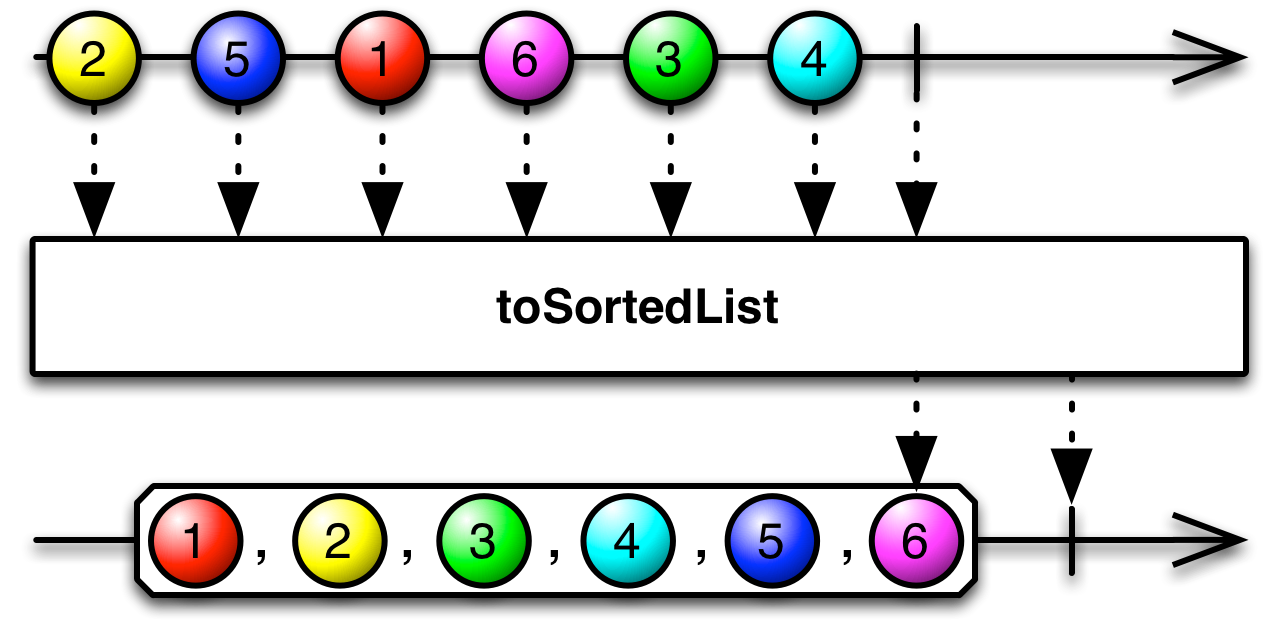
Observable that emits the items emitted by the source Observable, in a sorted order
(each item emitted by the Observable must implement Comparable with respect to all other
items in the sequence, or you must pass in a sort function).
| Modifier and Type | Class and Description |
|---|---|
| pack-priv static class |
| Modifier and Type | Field and Description |
|---|---|
| private static final Comparator | |
| pack-priv final int | |
| pack-priv final Comparator |
| Access | Constructor and Description |
|---|---|
| public | |
| public | OperatorToObservableSortedList(final Func2<? super T, ? super T, Integer> sortFunction, int initialCapacity)
|
| Modifier and Type | Method and Description |
|---|---|
| public Subscriber |
| DEFAULT_SORT_FUNCTION | back to summary |
|---|---|
private static final Comparator<T> DEFAULT_SORT_FUNCTION
| |
| initialCapacity | back to summary |
|---|---|
| pack-priv final int initialCapacity | |
| sortFunction | back to summary |
|---|---|
| pack-priv final Comparator<? super T> sortFunction | |
| OperatorToObservableSortedList | back to summary |
|---|---|
public OperatorToObservableSortedList(int initialCapacity)
| |
| OperatorToObservableSortedList | back to summary |
|---|---|
| public OperatorToObservableSortedList(final Func2<? super T, ? super T, Integer> sortFunction, int initialCapacity) | |
| call | back to summary |
|---|---|
| public Subscriber Implements rx.
| |
| Access | Constructor and Description |
|---|---|
| pack-priv |
| Modifier and Type | Method and Description |
|---|---|
| public int | compare(Object
the first object to be compared. t1, Object the second object to be compared. t2)Implements java. |
| DefaultComparableFunction | back to summary |
|---|---|
| pack-priv DefaultComparableFunction() | |
| compare | back to summary |
|---|---|
| public int compare(Object t1, Object t2) Implements java. Doc from java. Compares its two arguments for order. Returns a negative integer, zero, or a positive integer as the first argument is less than, equal to, or greater than the second.
The implementor must ensure that
The implementor must also ensure that the relation is transitive:
Finally, the implementor must ensure that
| |