


Deprecated
as of 3.4, this class is not used anymore and considered to be out of scope of Apache Commons Math
Ordering is done by encoding all components of the T-uple into a
single scalar value and using this value as the sorting
key. Encoding is performed using the method invented by Georg
Cantor in 1877 when he proved it was possible to establish a
bijection between a line and a plane. The binary representations of
the components of the T-uple are mixed together to form a single
scalar. This means that the 2k bit of component 0 is
followed by the 2k bit of component 1, then by the
2k bit of component 2 up to the 2k bit of
component t, which is followed by the 2k-1
bit of component 0, followed by the 2k-1 bit of
component 1 ... The binary representations are extended as needed
to handle numbers with different scales and a suitable
2p offset is added to the components in order to avoid
negative numbers (this offset is adjusted as needed during the
comparison operations).
The more interesting property of the encoding method for our purpose is that it allows to select all the points that are in a given range. This is depicted in dimension 2 by the following picture:
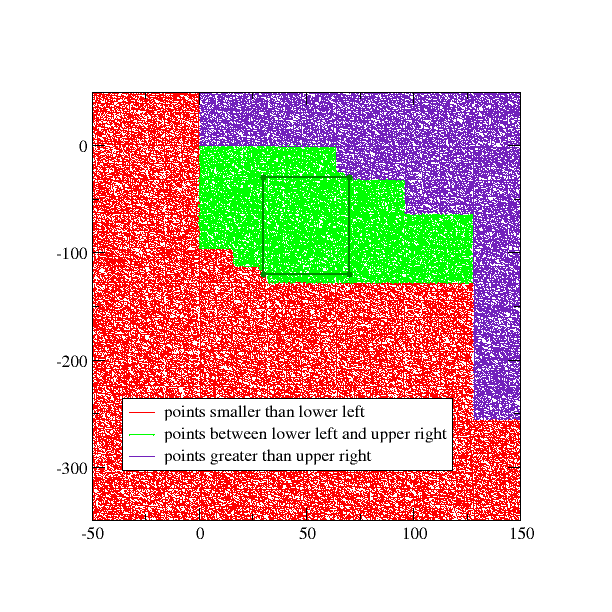
This picture shows a set of 100000 random 2-D pairs having their first component between -50 and +150 and their second component between -350 and +50. We wanted to extract all pairs having their first component between +30 and +70 and their second component between -120 and -30. We built the lower left point at coordinates (30, -120) and the upper right point at coordinates (70, -30). All points smaller than the lower left point are drawn in red and all points larger than the upper right point are drawn in blue. The green points are between the two limits. This picture shows that all the desired points are selected, along with spurious points. In this case, we get 15790 points, 4420 of which really belonging to the desired rectangle. It is possible to extract very small subsets. As an example extracting from the same 100000 points set the points having their first component between +30 and +31 and their second component between -91 and -90, we get a subset of 11 points, 2 of which really belonging to the desired rectangle.
the previous selection technique can be applied in all dimensions, still using two points to define the interval. The first point will have all its components set to their lower bounds while the second point will have all its components set to their upper bounds.
T-uples with negative infinite or positive infinite components are sorted logically.
Since the specification of the Comparator interface
allows only ClassCastException errors, some arbitrary
choices have been made to handle specific cases. The rationale for
these choices is to keep regular and consistent T-uples
together.
Double.NaN components are sorted
after all other ones (even after instances with positive infinite
componentsDouble.NaN
components| Modifier and Type | Field and Description |
|---|---|
| private double[] | components
Double components of the T-uple. |
| private long[] | encoding
Ordering encoding of the double components. |
| private static final long | EXPONENT_MASK
Exponent bits mask. |
| private static final long | IMPLICIT_ONE
Implicit MSB for normalized numbers. |
| private int | lsb
Least Significant Bit scale. |
| private static final long | MANTISSA_MASK
Mantissa bits mask. |
| private boolean | nan
Not A Number marker. |
| private boolean | negInf
Negative infinity marker. |
| private int | offset
Offset scale. |
| private boolean | posInf
Positive infinity marker. |
| private static final long | SIGN_MASK
Sign bit mask. |
| Access | Constructor and Description |
|---|---|
| public | OrderedTuple(final double...
double components of the T-uple components)Build an ordered T-uple from its components. |
| Modifier and Type | Method and Description |
|---|---|
| public int | Returns: a negative integer if the instance is less than the object, zero if they are equal, or a positive integer if the instance is greater than the objectT-uple to compare instance with ot)Implements java.
Deprecated
as a consequence of
OrderedTuple being deprecated.
Compares this ordered T-uple with the specified object. |
| private static int | Returns: scale of the least significant bit ofl,
or 63 if l is zerolong from which the least significant bit is requested l)Compute the least significant bit of a long. |
| private static int | Returns: scale of the most significant bit ofl,
or 0 if l is zerolong from which the most significant bit is requested l)Compute the most significant bit of a long. |
| private void | encode(final int
minimal scale of the offset to add to all
components (must be greater than the MSBs of all components) minOffset)Encode the T-uple with a given offset. |
| public boolean | equals(final Object
the reference object with which to compare. other)Overrides java. Indicates whether some other object is "equal to" this one. |
| private static int | Returns: exponentbinary representation of the double bits)Extract the exponent from the bits of a double. |
| private int | Returns: the specified bit (either 0 or 1), after the offset has been added to the doubleindex of the component i, final int scale of the requested bit k)Get a bit from the mantissa of a double. |
| public double[] | |
| public int | |
| private static long | Returns: mantissabinary representation of the double bits)Extract the mantissa from the bits of a double. |
| private static long | Returns: sign bit (zero if positive, non zero if negative)binary representation of the double bits)Extract the sign from the bits of a double. |
| components | back to summary |
|---|---|
| private double[] components Double components of the T-uple. | |
| encoding | back to summary |
|---|---|
| private long[] encoding Ordering encoding of the double components. | |
| EXPONENT_MASK | back to summary |
|---|---|
| private static final long EXPONENT_MASK Exponent bits mask. | |
| IMPLICIT_ONE | back to summary |
|---|---|
| private static final long IMPLICIT_ONE Implicit MSB for normalized numbers. | |
| lsb | back to summary |
|---|---|
| private int lsb Least Significant Bit scale. | |
| MANTISSA_MASK | back to summary |
|---|---|
| private static final long MANTISSA_MASK Mantissa bits mask. | |
| nan | back to summary |
|---|---|
| private boolean nan Not A Number marker. | |
| negInf | back to summary |
|---|---|
| private boolean negInf Negative infinity marker. | |
| offset | back to summary |
|---|---|
| private int offset Offset scale. | |
| posInf | back to summary |
|---|---|
| private boolean posInf Positive infinity marker. | |
| SIGN_MASK | back to summary |
|---|---|
| private static final long SIGN_MASK Sign bit mask. | |
| OrderedTuple | back to summary |
|---|---|
| public OrderedTuple(final double... components) Build an ordered T-uple from its components.
| |
| compareTo | back to summary |
|---|---|
| public int compareTo(final OrderedTuple ot) Implements java. Deprecated as a consequence of Compares this ordered T-uple with the specified object. The ordering method is detailed in the general description of the class. Its main property is to be consistent with distance: geometrically close T-uples stay close to each other when stored in a sorted collection using this comparison method. T-uples with negative infinite, positive infinite are sorted logically. Some arbitrary choices have been made to handle specific cases. The rationale for these choices is to keep normal and consistent T-uples together.
| |
| computeLSB | back to summary |
|---|---|
| private static int computeLSB(final long l) Compute the least significant bit of a long.
| |
| computeMSB | back to summary |
|---|---|
| private static int computeMSB(final long l) Compute the most significant bit of a long.
| |
| encode | back to summary |
|---|---|
| private void encode(final int minOffset) Encode the T-uple with a given offset.
| |
| equals | back to summary |
|---|---|
| public boolean equals(final Object other) Overrides java. Doc from java. Indicates whether some other object is "equal to" this one.
The
An equivalence relation partitions the elements it operates on into equivalence classes; all the members of an equivalence class are equal to each other. Members of an equivalence class are substitutable for each other, at least for some purposes. | |
| exponent | back to summary |
|---|---|
| private static int exponent(final long bits) Extract the exponent from the bits of a double.
| |
| getBit | back to summary |
|---|---|
| private int getBit(final int i, final int k) Get a bit from the mantissa of a double.
| |
| getComponents | back to summary |
|---|---|
| public double[] getComponents() Get the components array.
| |
| hashCode | back to summary |
|---|---|
| public int hashCode() Overrides java. Doc from java. Returns a hash code value for this object. This method is
supported for the benefit of hash tables such as those provided by
The general contract of
| |
| mantissa | back to summary |
|---|---|
| private static long mantissa(final long bits) Extract the mantissa from the bits of a double.
| |
| sign | back to summary |
|---|---|
| private static long sign(final long bits) Extract the sign from the bits of a double.
| |