


Action
instances, allowing for more complex controls like ToolBar,
MenuBar and ContextMenu to be automatically generated from
the collection of actions inside the ActionGroup. For your convenience,
there are a number of utility methods that do precisely this in the
ActionUtils class.
Consider the following code example (note that DummyAction is a fake class
that extends from (and implements) Action):
// Firstly, create a list of Actions
Collection<? extends Action> actions = Arrays.asList(
    new ActionGroup("Group 1",  new DummyAction("Action 1.1"),
                                new DummyAction("Action 2.1") ),
    new ActionGroup("Group 2",  new DummyAction("Action 2.1"),
                                new ActionGroup("Action 2.2", new DummyAction("Action 2.2.1"),
                                                              new DummyAction("Action 2.2.2")),
                                new DummyAction("Action 2.3") ),
    new ActionGroup("Group 3",  new DummyAction("Action 3.1"),
                                new DummyAction("Action 3.2") )
  );

  // Use the ActionUtils class to create UI controls from these actions, e.g:
  MenuBar menuBar = ActionUtils.createMenuBar(actions);

  ToolBar toolBar = ActionUtils.createToolBar(actions);

  Label context = new Label("Right-click to see the context menu");
  context.setContextMenu(ActionUtils.createContextMenu(actions));
The end result of running the code above is shown in the screenshots below (hopefully it goes without saying that within the 'Group 1', 'Group 2' and 'Group 3' options are the 'Action 1.1', etc actions that have been specified in the code above):
| MenuBar: |  |
| ToolBar: |  |
| ContextMenu: | 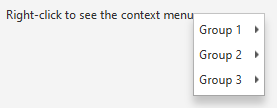 |
Action, ActionUtils
| Modifier and Type | Field and Description |
|---|---|
| private final ObservableList |
| Access | Constructor and Description |
|---|---|
| public | |
| public | ActionGroup(String text, Collection<Action>
Collection of actions to insert into this ActionGroup. actions)Creates an ActionGroup with the given text as the name of the |
| public | |
| public | ActionGroup(String text, Node icon, Collection<Action>
Collection of actions to insert into this ActionGroup. actions)Creates an ActionGroup with the given text as the name of the |
| Modifier and Type | Method and Description |
|---|---|
| public final ObservableList | |
| public String |
| actions | back to summary |
|---|---|
| private final ObservableList<Action> actions | |
| ActionGroup | back to summary |
|---|---|
| public ActionGroup(String text, Action... actions) Creates an ActionGroup with the given text as the name of the | |
| ActionGroup | back to summary |
|---|---|
| public ActionGroup(String text, Collection<Action> actions) Creates an ActionGroup with the given text as the name of the
| |
| ActionGroup | back to summary |
|---|---|
| public ActionGroup(String text, Node icon, Action... actions) Creates an ActionGroup with the given text as the name of the | |
| ActionGroup | back to summary |
|---|---|
| public ActionGroup(String text, Node icon, Collection<Action> actions) Creates an ActionGroup with the given text as the name of the | |
| getActions | back to summary |
|---|---|
| public final ObservableList The list of | |
| toString | back to summary |
|---|---|
| public String toString() Overrides java. Doc from java. Returns a string representation of the object.
Satisfying this method's contract implies a non-
| |