interpolate methods, which are
used to calculate interpolated values. Various built-in implementations of
this class are offered. Applications may choose to implement their own
Interpolator to get custom interpolation behavior.
A custom Interpolator has to be defined in terms of a "
curve()".
| Modifier and Type | Class and Description |
|---|---|
| public static enum | Interpolator.
Specifies the step position of a step interpolator. |
| Modifier and Type | Field and Description |
|---|---|
| public static final Interpolator | DISCRETE
Built-in interpolator that provides discrete time interpolation. |
| public static final Interpolator | EASE_BOTH
Built-in interpolator instance that provides ease in/out behavior. |
| public static final Interpolator | EASE_IN
Built-in interpolator instance that provides ease in behavior. |
| public static final Interpolator | EASE_OUT
Built-in interpolator instance that provides ease out behavior. |
| private static final double | |
| public static final Interpolator | LINEAR
Built-in interpolator instance that is equivalent to |
| public static final Interpolator | STEP_END
Built-in interpolator instance that is equivalent to |
| public static final Interpolator | STEP_START
Built-in interpolator instance that is equivalent to |
| Access | Constructor and Description |
|---|---|
| protected |
| Modifier and Type | Method and Description |
|---|---|
| private static double | |
| protected abstract double | Returns: the curved valuetime, but normalized to the range [0.0..1.0], where 0.0 is the
start of the current interval, while 1.0 is the end of the
current interval. Usually a function that increases
monotonically. t)Mapping from [0.0..1.0] to itself. |
| public Object | Returns: interpolated valuestart value startValue, Object end value endValue, double a value between 0.0 and 1.0 fraction)This method takes two |
| public boolean | Returns: the interpolated valuethe first data point startValue, boolean the second data point endValue, double the fraction in fraction)[0.0...1.0]This method takes two |
| public double | Returns: the interpolated valuethe first data point startValue, double the second data point endValue, double the fraction in fraction)[0.0...1.0]This method takes two |
| public int | Returns: the interpolated valuethe first data point startValue, int the second data point endValue, double the fraction in fraction)[0.0...1.0]This method takes two |
| public long | Returns: the interpolated valuethe first data point startValue, long the second data point endValue, double the fraction in fraction)[0.0...1.0]This method takes two |
| public static Interpolator | |
| public static Interpolator | Returns: a spline interpolatorx coordinate of the first control point x1, double y coordinate of the first control point y1, double x coordinate of the second control point x2, double y coordinate of the second control point y2)Returns an |
| public static Interpolator | Returns: a step interpolatorthe number of intervals in the step interpolator intervalCount, Interpolator.the positionStepPosition of the step interpolatorReturns a step interpolator that divides the input time into a series of intervals, each interval being equal in length, where each interval maps to a constant output time value. |
| public static Interpolator | |
| public static Interpolator | |
| public static Interpolator | Returns: a spline interpolatorx coordinate of the first control point x1, double y coordinate of the first control point y1, double x coordinate of the second control point x2, double y coordinate of the second control point y2)
Deprecated
since 26. use
ofSpline(double, double, double, double) instead
This is a legacy method named inconsistently with method naming conventions,
use |
| public static Interpolator | Returns: a new step interpolatorthe number of intervals in the step interpolator intervalCount, Interpolator.the positionStepPosition of the step interpolator
Deprecated
since 26. use
ofSteps(int, StepPosition) instead
This is a legacy method named inconsistently with method naming conventions,
use |
| public static Interpolator | Returns: a tangent interpolatorthe delta time of the in-tangent, relative to the KeyFrame t1, double the value of the in-tangent v1, Duration the delta time of the out-tangent, relative to the KeyFrame t2, double the value of the out-tangent v2)
Deprecated
since 26. use
ofTangent(Duration, double, Duration, double) instead
This is a legacy method named inconsistently with method naming conventions,
use |
| public static Interpolator | Returns: a tangent interpolatorthe delta time of the tangent t, double the value of the tangent v)
Deprecated
since 26. use
ofTangent(Duration, double) instead
This is a legacy method named inconsistently with method naming conventions,
use |
| DISCRETE | back to summary |
|---|---|
| public static final Interpolator DISCRETE Built-in interpolator that provides discrete time interpolation. The
return value of | |
| EASE_BOTH | back to summary |
|---|---|
| public static final Interpolator EASE_BOTH Built-in interpolator instance that provides ease in/out behavior. An ease-both interpolator will make an animation start slow, then accelerate and slow down again towards the end, all in a smooth manner. The implementation uses the algorithm for easing defined in SMIL 3.0 with an acceleration and deceleration factor of 0.2, respectively. | |
| EASE_IN | back to summary |
|---|---|
| public static final Interpolator EASE_IN Built-in interpolator instance that provides ease in behavior. An ease-in interpolator will make an animation start slow and then accelerate smoothly. The implementation uses the algorithm for easing defined in SMIL 3.0 with an acceleration factor of 0.2. | |
| EASE_OUT | back to summary |
|---|---|
| public static final Interpolator EASE_OUT Built-in interpolator instance that provides ease out behavior. An ease-out interpolator will make an animation slow down toward the end smoothly. The implementation uses the algorithm for easing defined in SMIL 3.0 with an deceleration factor of 0.2. | |
| EPSILON | back to summary |
|---|---|
| private static final double EPSILON | |
| LINEAR | back to summary |
|---|---|
| public static final Interpolator LINEAR Built-in interpolator instance that is equivalent to | |
| STEP_END | back to summary |
|---|---|
| public static final Interpolator STEP_END Built-in interpolator instance that is equivalent to
| |
| STEP_START | back to summary |
|---|---|
| public static final Interpolator STEP_START Built-in interpolator instance that is equivalent to
| |
| Interpolator | back to summary |
|---|---|
| protected Interpolator() The constructor of | |
| clamp | back to summary |
|---|---|
| private static double clamp(double t) | |
| curve | back to summary |
|---|---|
| protected abstract double curve(double t) Mapping from [0.0..1.0] to itself.
| |
| interpolate | back to summary |
|---|---|
| public Object interpolate(Object startValue, Object endValue, double fraction) This method takes two
If both
Before calculating the interpolated value, the fraction is altered
according to the function defined in
| |
| interpolate | back to summary |
|---|---|
| public boolean interpolate(boolean startValue, boolean endValue, double fraction) This method takes two
Before calculating the interpolated value, the fraction is altered
according to the function defined in
| |
| interpolate | back to summary |
|---|---|
| public double interpolate(double startValue, double endValue, double fraction) This method takes two
Before calculating the interpolated value, the fraction is altered
according to the function defined in
| |
| interpolate | back to summary |
|---|---|
| public int interpolate(int startValue, int endValue, double fraction) This method takes two
Before calculating the interpolated value, the fraction is altered
according to the function defined in
| |
| interpolate | back to summary |
|---|---|
| public long interpolate(long startValue, long endValue, double fraction) This method takes two
Before calculating the interpolated value, the fraction is altered
according to the function defined in
| |
| ofLinear | back to summary |
|---|---|
| public static Interpolator ofLinear(Point2D... controlPoints) Returns an interpolator that interpolates linearly between its specified control points.
Each control point associates an input progress value (X) with an output progress value (Y).
The input progress value is the normalized progress of the animation, while the output progress
value is the normalized progress of the value change. This means that when the time has reached
X of the animation, the animation should be at Y of its value change. Both values are specified
in normalized coordinates, but are not required to fall within the
If the input progress value (X) of a control point is unspecified ( The control point list is canonicalized so that input progress values (X) are non-decreasing in the order provided. In particular, if a control point specifies an X value that is lower than any preceding control point's X value, it is adjusted to match the greatest preceding X value.
| |
| ofSpline | back to summary |
|---|---|
| public static Interpolator ofSpline(double x1, double y1, double x2, double y2) Returns an
| |
| ofSteps | back to summary |
|---|---|
| public static Interpolator ofSteps(int intervalCount, Interpolator. Returns a step interpolator that divides the input time into a series of intervals, each
interval being equal in length, where each interval maps to a constant output time value.
The output time value is determined by the
| |
| ofTangent | back to summary |
|---|---|
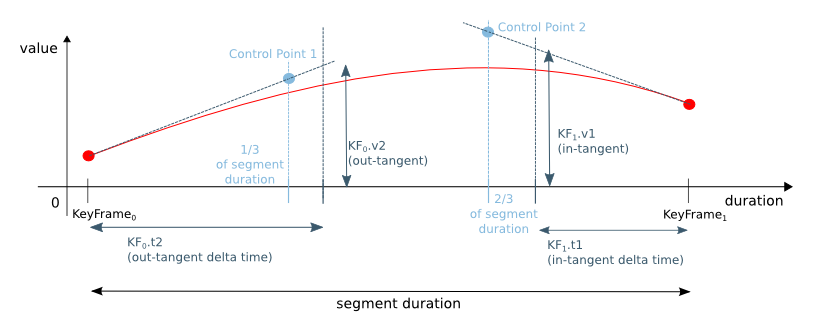
| public static Interpolator ofTangent(Duration t1, double v1, Duration t2, double v2) Returns a tangent interpolator. A tangent interpolator allows to define
the behavior of an animation curve very precisely by defining the
tangents close to a key frame.
A tangent interpolator defines the behavior to the left and to the right
of a key frame, therefore it is only useful within a
The parameters define the tangent of the animation curve for the in tangent (before a key frame) and out tangent (after a key frame). Each tangent is specified with a pair, the distance to the key frame and the value of the tangent at this moment. The interpolation then follows a bezier curve, with 2 control points defined by the specified tangent and positioned at 1/3 of the duration before the second KeyFrame or after the first KeyFrame. See the picture above.
| |
| ofTangent | back to summary |
|---|---|
| public static Interpolator ofTangent(Duration t, double v) Returns a tangent interpolator, for which in-tangent and out-tangent are
identical. This is especially useful for the first and the last key frame
of a
| |
| SPLINE | back to summary |
|---|---|
| public static Interpolator SPLINE(double x1, double y1, double x2, double y2)
This is a legacy method named inconsistently with method naming conventions,
use
| |
| STEPS | back to summary |
|---|---|
| public static Interpolator STEPS(int intervalCount, Interpolator. This is a legacy method named inconsistently with method naming conventions,
use
| |
| TANGENT | back to summary |
|---|---|
| public static Interpolator TANGENT(Duration t1, double v1, Duration t2, double v2)
This is a legacy method named inconsistently with method naming conventions,
use
| |
| TANGENT | back to summary |
|---|---|
| public static Interpolator TANGENT(Duration t, double v)
This is a legacy method named inconsistently with method naming conventions,
use
| |
The step position determines the location of rise points in the input progress interval, which are the locations on the input progress axis where the output progress value jumps from one step to the next.
| Modifier and Type | Field and Description |
|---|---|
| public static final Interpolator. | BOTH
The interval starts with a rise point when the input progress value is 0, and ends with a rise point when the input progress value is 1. |
| public static final Interpolator. | END
The interval ends with a rise point when the input progress value is 1. |
| public static final Interpolator. | NONE
All rise points are within the open interval (0..1). |
| public static final Interpolator. | START
The interval starts with a rise point when the input progress value is 0. |
| Access | Constructor and Description |
|---|---|
| private |
| Modifier and Type | Method and Description |
|---|---|
| public static Interpolator. | |
| public static Interpolator. |
| BOTH | back to summary |
|---|---|
| public static final Interpolator. The interval starts with a rise point when the input progress value is 0, and ends with a rise point when the input progress value is 1.
| |
| END | back to summary |
|---|---|
| public static final Interpolator. The interval ends with a rise point when the input progress value is 1.
| |
| NONE | back to summary |
|---|---|
| public static final Interpolator. All rise points are within the open interval (0..1).
| |
| START | back to summary |
|---|---|
| public static final Interpolator. The interval starts with a rise point when the input progress value is 0.
| |
| StepPosition | back to summary |
|---|---|
| private StepPosition() | |
| valueOf | back to summary |
|---|---|
| public static Interpolator. | |
| values | back to summary |
|---|---|
| public static Interpolator. | |