

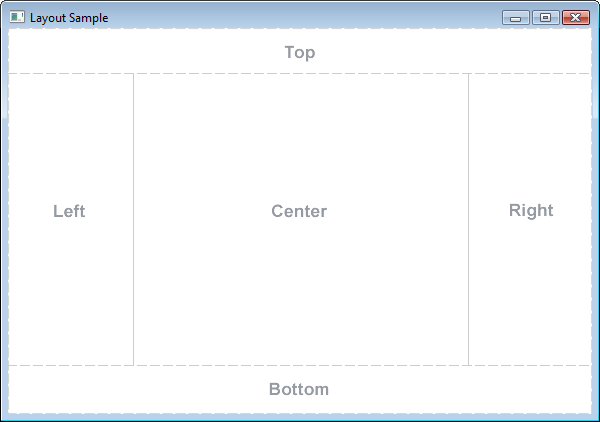
     BorderPane borderPane = new BorderPane();
    ToolBar toolbar = new ToolBar();
    HBox statusbar = new HBox();
    Node appContent = new AppContentNode();
    borderPane.setTop(toolbar);
    borderPane.setCenter(appContent);
    borderPane.setBottom(statusbar);
Borderpanes may be styled with backgrounds and borders using CSS. See
Region superclass for details.
BorderPane honors the minimum, preferred, and maximum sizes of its children. If the child's resizable range prevents it from be resized to fit within its position, it will be aligned relative to the space using a default alignment as follows:
BorderPane lays out each child set in the five positions regardless of the child's visible property value; unmanaged children are ignored.
BorderPane is commonly used as the root of a Scene,
in which case its size will track the size of the scene. If the scene or stage
size has not been directly set by the application, the scene size will be
initialized to the border pane's preferred size. However, if a border pane
has a parent other than the scene, that parent will resize the border pane within
the border pane's resizable range during layout. By default the border pane
computes this range based on its content as outlined in the table below.
| width | height | |
|---|---|---|
| minimum | left/right insets plus width required to display right/left children at their pref widths and top/bottom/center with at least their min widths | top/bottom insets plus height required to display top/bottom children at their pref heights and left/right/center with at least their min heights |
| preferred | left/right insets plus width required to display top/right/bottom/left/center children with at least their pref widths | top/bottom insets plus height required to display top/right/bottom/left/center children with at least their pref heights |
| maximum | Double.MAX_VALUE | Double.MAX_VALUE |
A border pane's unbounded maximum width and height are an indication to the parent that it may be resized beyond its preferred size to fill whatever space is assigned to it.
BorderPane provides properties for setting the size range directly. These properties default to the sentinel value Region.USE_COMPUTED_SIZE, however the application may set them to other values as needed:
borderPane.setPrefSize(500,400);
BorderPane does not clip its content by default, so it is possible that children's bounds may extend outside its own bounds if a child's min size prevents it from being fit within it space.
An application may set constraints on individual children to customize BorderPane's layout. For each constraint, BorderPane provides a static method for setting it on the child.
| Constraint | Type | Description |
|---|---|---|
| alignment | javafx.geometry.Pos | The alignment of the child within its area of the border pane. |
| margin | javafx.geometry.Insets | Margin space around the outside of the child. |
Example:
     ListView list = new ListView();
    BorderPane.setAlignment(list, Pos.TOP_LEFT);
    BorderPane.setMargin(list, new Insets(12,12,12,12));
    borderPane.setCenter(list);
| Modifier and Type | Class and Description |
|---|---|
| private class |
| Modifier and Type | Field and Description |
|---|---|
| private static final String | |
| private ObjectProperty | |
| private ObjectProperty | |
| private ObjectProperty | left
Hides javafx. |
| private static final String | |
| private ObjectProperty | |
| private ObjectProperty | top
Hides javafx. |
| Access | Constructor and Description |
|---|---|
| public | |
| public | BorderPane(Node
The node to set as the center of the BorderPane. center)Creates an BorderPane layout with the given Node as the center of the BorderPane. |
| public | BorderPane(Node
The node to set as the center of the BorderPane. center, Node The node to set as the top of the BorderPane. top, Node The node to set as the right of the BorderPane. right, Node The node to set as the bottom of the BorderPane. bottom, Node The node to set as the left of the BorderPane. left)Creates an BorderPane layout with the given Nodes to use for each of the main layout areas of the Border Pane. |
| Modifier and Type | Method and Description |
|---|---|
| public final ObjectProperty | Returns: the node placed on the bottom edge of this border paneThe node placed on the bottom edge of this border pane. |
| public final ObjectProperty | Returns: the node placed in the center of this border paneThe node placed in the center of this border pane. |
| private boolean | |
| public static void | |
| protected double | computeMinHeight(double width)
Overrides javafx. Computes the minimum height of this region. |
| protected double | computeMinWidth(double height)
Overrides javafx. Computes the minimum width of this region. |
| protected double | computePrefHeight(double width)
Overrides javafx. Computes the preferred height of this region for the given width; Region subclasses should override this method to return an appropriate value based on their content and layout strategy. |
| protected double | computePrefWidth(double height)
Overrides javafx. Computes the preferred width of this region for the given height. |
| public static Pos | Returns: the alignment position for the child or null if no alignment was setthe child node of a border pane child)Returns the child's alignment constraint if set. |
| private double | |
| private double | |
| public final Node | |
| public final Node | |
| public Orientation | Returns: null unless the center, right, bottom, left or top has a content bias.Overrides javafx. Returns the orientation of a node's resizing bias for layout purposes. |
| public final Node | |
| public static Insets | |
| private static Insets | |
| public final Node | |
| public final Node | |
| protected void | layoutChildren()
Overrides javafx. Invoked during the layout pass to layout the children in this
|
| public final ObjectProperty | Returns: the node placed on the left edge of this border paneThe node placed on the left edge of this border pane. |
| public final ObjectProperty | Returns: the node placed on the right edge of this border paneThe node placed on the right edge of this border pane. |
| public static void | setAlignment(Node
the child node of a border pane child, Pos the alignment position for the child value)Sets the alignment for the child when contained by a border pane. |
| public final void | |
| public final void | |
| public final void | |
| public static void | |
| public final void | |
| public final void | |
| public final ObjectProperty | Returns: the node placed on the top edge of this border paneThe node placed on the top edge of this border pane. |
| ALIGNMENT | back to summary |
|---|---|
| private static final String ALIGNMENT | |
| bottom | back to summary |
|---|---|
| private ObjectProperty<Node> bottom Hides javafx. | |
| center | back to summary |
|---|---|
| private ObjectProperty<Node> center | |
| left | back to summary |
|---|---|
| private ObjectProperty<Node> left Hides javafx. | |
| MARGIN | back to summary |
|---|---|
| private static final String MARGIN | |
| right | back to summary |
|---|---|
| private ObjectProperty<Node> right Hides javafx. | |
| top | back to summary |
|---|---|
| private ObjectProperty<Node> top Hides javafx. | |
| BorderPane | back to summary |
|---|---|
| public BorderPane() Creates a BorderPane layout. | |
| BorderPane | back to summary |
|---|---|
| public BorderPane(Node center) Creates an BorderPane layout with the given Node as the center of the BorderPane.
| |
| BorderPane | back to summary |
|---|---|
| public BorderPane(Node center, Node top, Node right, Node bottom, Node left) Creates an BorderPane layout with the given Nodes to use for each of the main layout areas of the Border Pane. The top, right, bottom, and left nodes are listed in clockwise order.
| |
| bottomProperty | back to summary |
|---|---|
| public final ObjectProperty The node placed on the bottom edge of this border pane. If resizable, it will be resized to its preferred height and it's width will span the width of the border pane. If the node cannot be resized to fill the bottom space (it's not resizable or its max size prevents it) then it will be aligned bottom-left within the space unless the child's alignment constraint has been set.
| |
| centerProperty | back to summary |
|---|---|
| public final ObjectProperty The node placed in the center of this border pane. If resizable, it will be resized fill the center of the border pane between the top, bottom, left, and right nodes. If the node cannot be resized to fill the center space (it's not resizable or its max size prevents it) then it will be center aligned unless the child's alignment constraint has been set.
| |
| childHasContentBias | back to summary |
|---|---|
| private boolean childHasContentBias(Node child, Orientation orientation) | |
| clearConstraints | back to summary |
|---|---|
| public static void clearConstraints(Node child) Removes all border pane constraints from the child node.
| |
| computeMinHeight | back to summary |
|---|---|
| protected double computeMinHeight(double width) Overrides javafx. Doc from javafx. Computes the minimum height of this region. Returns the sum of the top and bottom insets by default. Region subclasses should override this method to return an appropriate value based on their content and layout strategy. If the subclass doesn't have a HORIZONTAL content bias, then the width parameter can be ignored.
| |
| computeMinWidth | back to summary |
|---|---|
| protected double computeMinWidth(double height) Overrides javafx. Doc from javafx. Computes the minimum width of this region. Returns the sum of the left and right insets by default. region subclasses should override this method to return an appropriate value based on their content and layout strategy. If the subclass doesn't have a VERTICAL content bias, then the height parameter can be ignored.
| |
| computePrefHeight | back to summary |
|---|---|
| protected double computePrefHeight(double width) Overrides javafx. Doc from javafx. Computes the preferred height of this region for the given width; Region subclasses should override this method to return an appropriate value based on their content and layout strategy. If the subclass doesn't have a HORIZONTAL content bias, then the width parameter can be ignored.
| |
| computePrefWidth | back to summary |
|---|---|
| protected double computePrefWidth(double height) Overrides javafx. Doc from javafx. Computes the preferred width of this region for the given height. Region subclasses should override this method to return an appropriate value based on their content and layout strategy. If the subclass doesn't have a VERTICAL content bias, then the height parameter can be ignored.
| |
| getAlignment | back to summary |
|---|---|
| public static Pos getAlignment(Node child) Returns the child's alignment constraint if set. | |
| getAreaHeight | back to summary |
|---|---|
| private double getAreaHeight(Node child, double width, boolean minimum) | |
| getAreaWidth | back to summary |
|---|---|
| private double getAreaWidth(Node child, double height, boolean minimum) | |
| getBottom | back to summary |
|---|---|
| public final Node getBottom() | |
| getCenter | back to summary |
|---|---|
| public final Node getCenter() | |
| getContentBias | back to summary |
|---|---|
| public Orientation getContentBias() Overrides javafx. Doc from javafx. Returns the orientation of a node's resizing bias for layout purposes. If the node type has no bias, returns null. If the node is resizable and it's height depends on its width, returns HORIZONTAL, else if its width depends on its height, returns VERTICAL. Resizable subclasses should override this method to return an appropriate value.
| |
| getLeft | back to summary |
|---|---|
| public final Node getLeft() | |
| getMargin | back to summary |
|---|---|
| public static Insets getMargin(Node child) Returns the child's margin constraint if set. | |
| getNodeMargin | back to summary |
|---|---|
| private static Insets getNodeMargin(Node child) | |
| getRight | back to summary |
|---|---|
| public final Node getRight() | |
| getTop | back to summary |
|---|---|
| public final Node getTop() | |
| layoutChildren | back to summary |
|---|---|
| protected void layoutChildren() Overrides javafx. Doc from javafx. Invoked during the layout pass to layout the children in this
Subclasses should override this function to layout content as needed.
| |
| leftProperty | back to summary |
|---|---|
| public final ObjectProperty The node placed on the left edge of this border pane. If resizable, it will be resized to its preferred width and it's height will span the height of the border pane between the top and bottom nodes. If the node cannot be resized to fill the left space (it's not resizable or its max size prevents it) then it will be aligned top-left within the space unless the child's alignment constraint has been set.
| |
| rightProperty | back to summary |
|---|---|
| public final ObjectProperty The node placed on the right edge of this border pane. If resizable, it will be resized to its preferred width and it's height will span the height of the border pane between the top and bottom nodes. If the node cannot be resized to fill the right space (it's not resizable or its max size prevents it) then it will be aligned top-right within the space unless the child's alignment constraint has been set.
| |
| setAlignment | back to summary |
|---|---|
| public static void setAlignment(Node child, Pos value) Sets the alignment for the child when contained by a border pane. If set, will override the border pane's default alignment for the child's position. Setting the value to null will remove the constraint. | |
| setBottom | back to summary |
|---|---|
| public final void setBottom(Node value) | |
| setCenter | back to summary |
|---|---|
| public final void setCenter(Node value) | |
| setLeft | back to summary |
|---|---|
| public final void setLeft(Node value) | |
| setMargin | back to summary |
|---|---|
| public static void setMargin(Node child, Insets value) Sets the margin for the child when contained by a border pane. If set, the border pane will lay it out with the margin space around it. Setting the value to null will remove the constraint. | |
| setRight | back to summary |
|---|---|
| public final void setRight(Node value) | |
| setTop | back to summary |
|---|---|
| public final void setTop(Node value) | |
| topProperty | back to summary |
|---|---|
| public final ObjectProperty The node placed on the top edge of this border pane. If resizable, it will be resized to its preferred height and it's width will span the width of the border pane. If the node cannot be resized to fill the top space (it's not resizable or its max size prevents it) then it will be aligned top-left within the space unless the child's alignment constraint has been set.
| |
| Modifier and Type | Field and Description |
|---|---|
| private boolean | |
| private Node | |
| private final String |
| Access | Constructor and Description |
|---|---|
| pack-priv |
| Modifier and Type | Method and Description |
|---|---|
| public Object | getBean()
Implements javafx. Returns the |
| public String | getName()
Implements javafx. Returns the name of this property. |
| protected void | invalidated()
Overrides javafx. The method |
| isBeingInvalidated | back to summary |
|---|---|
| private boolean isBeingInvalidated | |
| oldValue | back to summary |
|---|---|
| private Node oldValue | |
| propertyName | back to summary |
|---|---|
| private final String propertyName | |
| BorderPositionProperty | back to summary |
|---|---|
| pack-priv BorderPositionProperty(String propertyName) | |
| getBean | back to summary |
|---|---|
| public Object getBean() Implements javafx. Doc from javafx. Returns the
| |
| getName | back to summary |
|---|---|
| public String getName() Implements javafx. Doc from javafx. Returns the name of this property. If the property does not have a name,
this method returns an empty
| |
| invalidated | back to summary |
|---|---|
| protected void invalidated() Overrides javafx. Doc from javafx. The method
| |

